
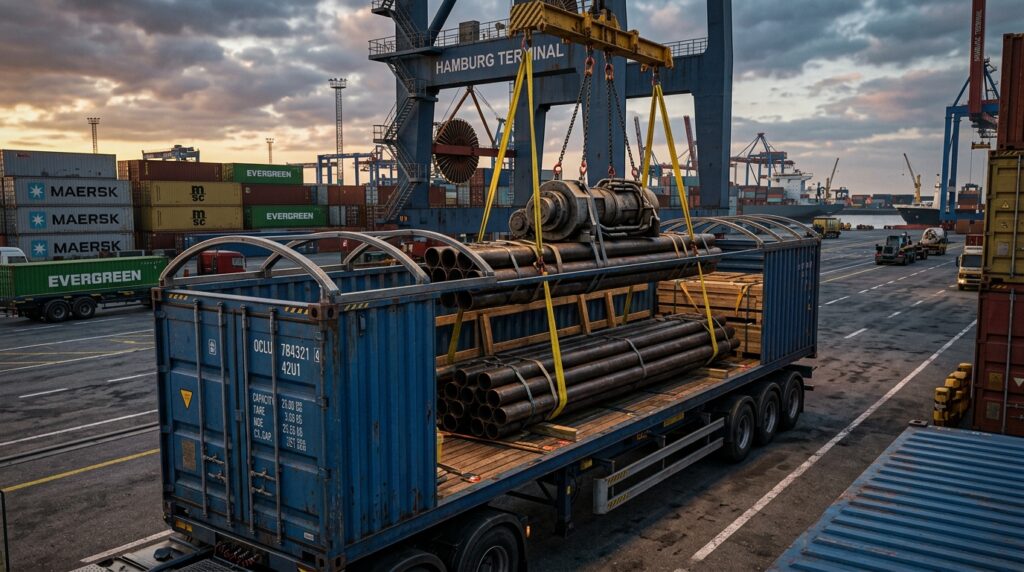
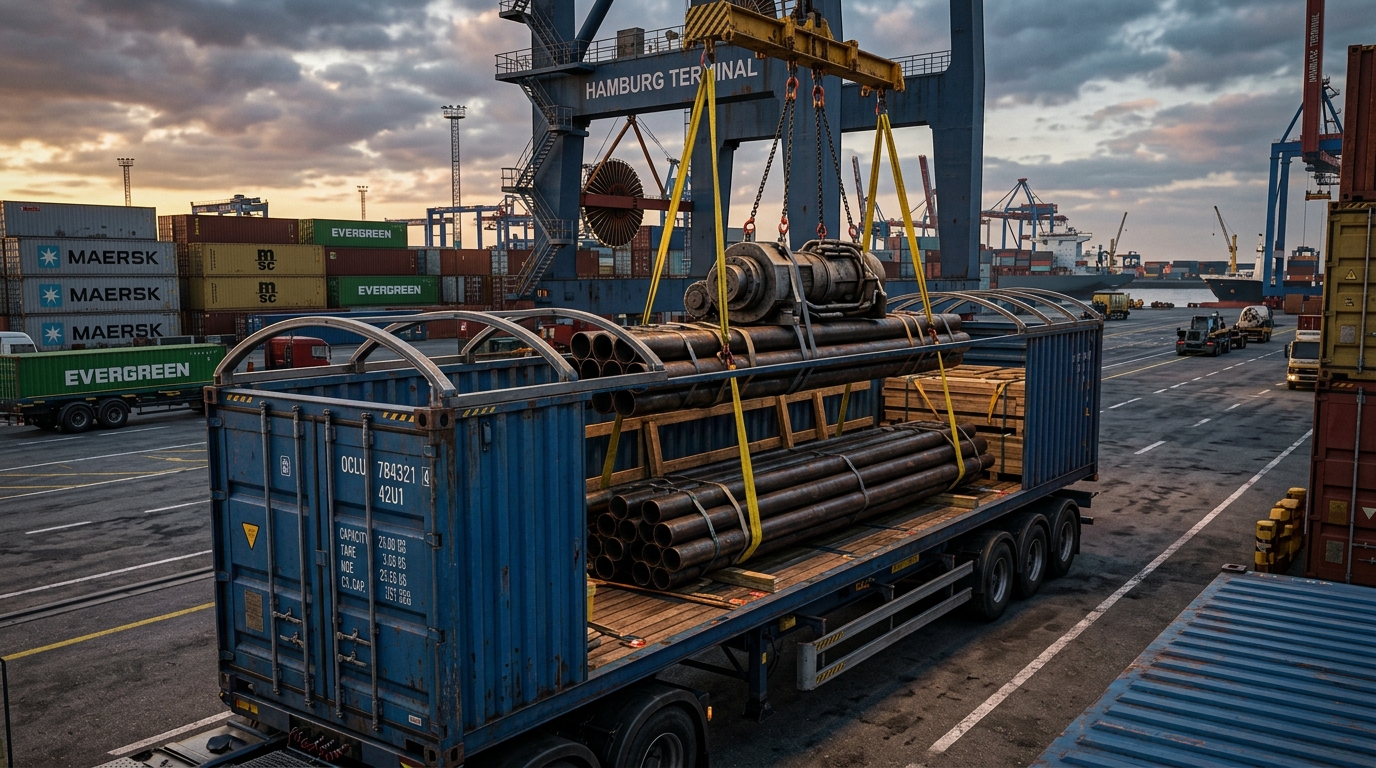
Quick Answer: The 40′ Open Top (Equipment Code: 40OT) container delivers an internal usable planning envelope of 1,200.0 cm L × 235.0 cm W × 235.0 cm H (39′ 4.4″ L × 7′ 8.5″ W × 7′ 8.5″ H) with a usable volume of 66.4 m³ (2,345 cu ft) and a cargo payload rating of 26,500 kg (58,422 lbs). Engineered for long industrial equipment, structural beams, and heavy machinery, it features a clear overhead crane roof opening of 1,157.5 cm × 223.0 cm, removable roof bows, weatherproof TIR tarpaulin, and a removable rear door header for seamless horizontal forklift entry.
Key Technical Specifications (Dual Metric & Imperial)
The 40′ Open Top container is engineered to rigorous ISO standards for specialized cargo logistics. The following technical parameters represent the validated engineering profile for 40OT in CBM3:
| Specification Parameter | Metric (ISO Standard) | Imperial (US Standard) |
|---|---|---|
| Equipment Code & Class | 40OT (40ft Open Top Shipping Container) | ISO 1496-1 Standard |
| Internal Usable Length | 1,200.0 cm | 39 ft 4.4 in |
| Internal Usable Width | 235.0 cm | 7 ft 8.5 in |
| Internal Usable Height | 235.0 cm | 7 ft 8.5 in |
| Top Roof Opening (L × W) | 1,157.5 × 223.0 cm | 37 ft 11.7 in × 7 ft 3.8 in |
| Rear Door Clearance (W × H) | 234.0 × 227.8 cm | 92.1 × 89.7 in (Removable header) |
| Usable Internal Volume | 66.4 m³ (CBM) | 2,345 cu ft |
| Maximum Gross Mass (MGM) | 32,500 kg | 71,650 lbs |
| Tare Weight (with tarp & bows) | 3,850 kg | 8,488 lbs |
| Maximum Net Cargo Payload | 26,500 kg (up to 28,650 kg) | 58,422 lbs |
| Euro Pallets (1200×800 mm / EUR 1) | 24–25 pallets on floor (48–50 double-stacked) | |
| Standard GMA Pallets (48×40 in / 1219×1016 mm) | 20–21 pallets on floor (40–42 double-stacked) | |
| Roof Cover & Weatherproofing | Removable weatherproof tarpaulin with TIR wire and arched roof bows | |
Heavy Machinery, Top-Loading Logistics & Crane Operations
The 40′ Open Top (Equipment Code: 40OT) is the premier intermodal solution for freight that cannot be handled through conventional container end doors. Heavy crated industrial machinery, structural steel beams, large marble slabs, oilfield valves, and architectural glass modules present geometric and physical weight challenges that forklift tines cannot safely maneuver.
The open top architecture transforms loading dynamics by allowing overhead gantry cranes, boom cranes, and forklift spreader bars to lower cargo directly into position from above. Key structural design features maximize loading flexibility:
1. Top Rail Roof Ingress: Note that the clear roof opening is slightly narrower than the internal container width (223 cm vs 235 cm) due to the heavy reinforced top side rails that bear longitudinal stacking loads on container ships.
2. Swing-Out Removable Rear Door Header: The top horizontal beam above the rear doors unlatches and pivots open or detaches entirely. This eliminates the height restriction during forklift approach, enabling tall cargo or heavy skids to be driven in horizontally without catching the roof frame.
Interactive 3D Cargo Load Simulation
Verify your precise carton configuration, pallet patterns, airflow clearances, and gross axle weights before shipping. Use our free 40 open top loading calculator to generate interactive 3D container stuffing diagrams and maximize usable volume.
Structural Rigidity, Removable Roof Bows & Tarpaulin Weatherproofing
Unlike dry containers whose rigid corrugated steel roof contributes to structural integrity, the 40OT relies on heavy-duty high-tensile steel top side rails and corner castings to withstand torsional forces at sea and 9-high container stack loads. Weather protection is provided by a reinforced PVC/vinyl tarpaulin held in place by a continuous TIR security cable passed through lashing rings along the exterior top rails. Beneath the tarpaulin, arched steel roof bows span the width of the container at regular intervals, preventing rain and snow from pooling while providing lateral support to the side walls. Before overhead crane loading, riggers remove the tarpaulin and unslot the roof bows. Once cargo is secured, the bows and tarpaulin are reinstalled and sealed.
Weight Distribution, Axle Limits & Transport Safety
Open top containers routinely carry dense, concentrated cargo such as transformers, engines, and steel coils. Concentrating heavy weight in a small floor area can exceed the concentrated floor load limit of the container (typically 4.5 to 5.5 tons per running meter) or cause localized floor puncture. Shippers must use heavy timber dunnage runners or steel spreader beams to distribute cargo weight over multiple crossmembers. Furthermore, open top containers feature heavy-duty interior lashing rings (rated at 1,500 to 2,000 kg tensile strength) along the bottom and top rails to anchor heavy machinery against longitudinal braking forces and vessel rolling.
How to Plan a 40′ Open Top (40OT) Load in CBM3 (Step-by-Step UI Guide)
Planning your 40′ Open Top shipment is fast, intuitive, and 100% free with no registration required on CBM3. Follow these simple steps in the interactive calculator interface:- Select Equipment Profile: In the “Load Space & Units” control card, click the Load Space dropdown (or type in the instant search box) and select 40OT — 40′ Open Top under the Sea Containers group. CBM3 instantly locks the precise usable dimensions, door clearances, and payload thresholds.
- Choose Your Measurement Units: Toggle seamlessly between Metric (cm / kg) and Imperial (inches / lbs) to match your commercial invoice and packing list.
- Input Cargo Dimensions & Quantities: Add individual package items or choose standard pallet presets (EUR 1, EUR 2, GMA/US Pallet). Enter length, width, height, unit weight, and total pieces.
- Configure Stacking & Orientation Rules: Set rotation allowances (e.g. “Keep Upright” for crated equipment or liquid bottles) and maximum allowable stacking layers or load limits. For open top loads, CBM3 visualizes the unobstructed overhead crane entry perspective.
- Run 3D Stuffing Simulation: Click “Calculate” to instantly generate the interactive 3D cargo arrangement. Rotate 360°, inspect layer-by-layer packing sequence, view center of gravity, and check axle load distribution.
- Export Packing Manifest & Visuals: Download professional PDF or Excel loading reports containing full packing manifests and 3D visual diagrams to share directly with warehouse loaders and freight forwarders.
6 Costly 40′ Open Top Load Planning Mistakes to Avoid
- Assuming Roof Opening Equals Interior Width: Top side rails reduce the clear crane entry width to 223 cm, while interior width is 235 cm. Ensure cargo passes top rails.
- Ignoring Roof Bow Clearance Under Tarpaulin: In-gauge cargo loaded right at ceiling height can clash with the arched roof bows when reinstalling the cover.
- Forgetting the Swing-Out Rear Door Header: Forcing tall cargo through end doors without swinging open the header beam can strike and damage the container frame.
- Concentrated Point-Loading on Floor: Heavy machinery resting on small feet can punch through floor boards. Always use load-spreading timber dunnage sleepers.
- Unsecured OOG (Out-of-Gauge) Over-Height Booking: Shipping cargo that protrudes above the roof without advance carrier OOG slot booking will result in port rejection.
- Damaged or Missing TIR Tarpaulin Cord: Customs authorities require intact TIR wire cables through eyelets; broken seals cause severe customs clearance delays.
Related Equipment Loading Guides & 3D Planners
Compare specifications, pallet stacking efficiency, and dimensional constraints with related logistics equipment:
- 20′ Standard Reefer (20RF) Loading Guide & Calculator — 27.7 m³ volume, 9-10 Euro pallets, cold chain perishable logistics
- 40′ Standard Reefer (40RF) Loading Guide & Calculator — 59.5 m³ volume, 20-21 Euro pallets, global ocean reefer shipping
- 40′ High Cube Reefer (40RHC) Loading Guide & Calculator — 64.4 m³ volume, extra 30 cm vertical clearance, high-volume chilled cargo
- 20′ Open Top (20OT) Loading Guide & Calculator — 32.9 m³ volume, 5.48m crane roof opening, heavy machinery & marble
- 40′ Open Top (40OT) Loading Guide & Calculator — 66.4 m³ volume, 11.57m crane roof opening, long industrial components
- All Loading Space Guides & Equipment Directory — Full catalog of dry, reefer, open top, flat rack, trailer & intermodal specs
Frequently Asked Questions (FAQ)
What are the dimensions and roof opening of a 40' Open Top container?
Internal dimensions are 1,200 cm (39 ft 4.4 in) length, 235 cm (7 ft 8.5 in) width, and 235 cm (7 ft 8.5 in) height. The clear top roof opening between longitudinal top rails is 1,157.5 cm (37 ft 11.7 in) long by 223.0 cm (7 ft 3.8 in) wide.
What is the maximum cargo payload for a 40' Open Top container?
The maximum cargo payload is 26,500 kg (58,422 lbs) to 28,650 kg depending on carrier series, with a maximum gross mass of 32,500 kg to 34,000 kg and an average tare weight of 3,850 kg.
How does the swing-out rear door header work on a 40OT container?
The top rear door header can be unlatched and swung open to the side or removed completely. This allows forklifts to drive long pipes, steel beams, or tall crated cargo directly into the container horizontally without catching on the upper door frame.
How many pallets fit into a 40' Open Top container?
A 40' Open Top container accommodates 24 to 25 Euro pallets (1200×800 mm) or 20 to 21 standard GMA pallets (48×40 in) on a single floor layer, identical to standard 40ft dry containers.