
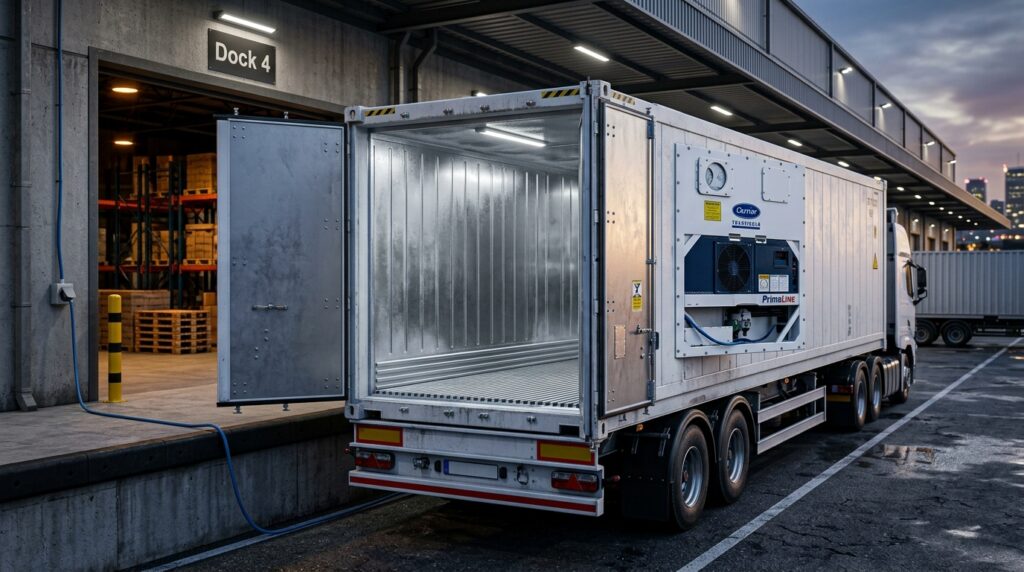
Quick Answer: The 20′ Standard Reefer (Equipment Code: 20RF) provides an internal usable planning envelope of 544.0 cm L × 227.0 cm W × 224.0 cm H (17′ 10.2″ L × 7′ 5.4″ W × 7′ 4.2″ H) with an internal volume of 27.7 m³ (978 cu ft) and a certified cargo payload of 27,400 kg (60,407 lbs). Engineered specifically for perishable cold chain logistics, the 20RF accommodates 9 to 10 Euro pallets or 8 GMA pallets on the floor while maintaining forced bottom-up airflow via aluminum T-bar flooring.
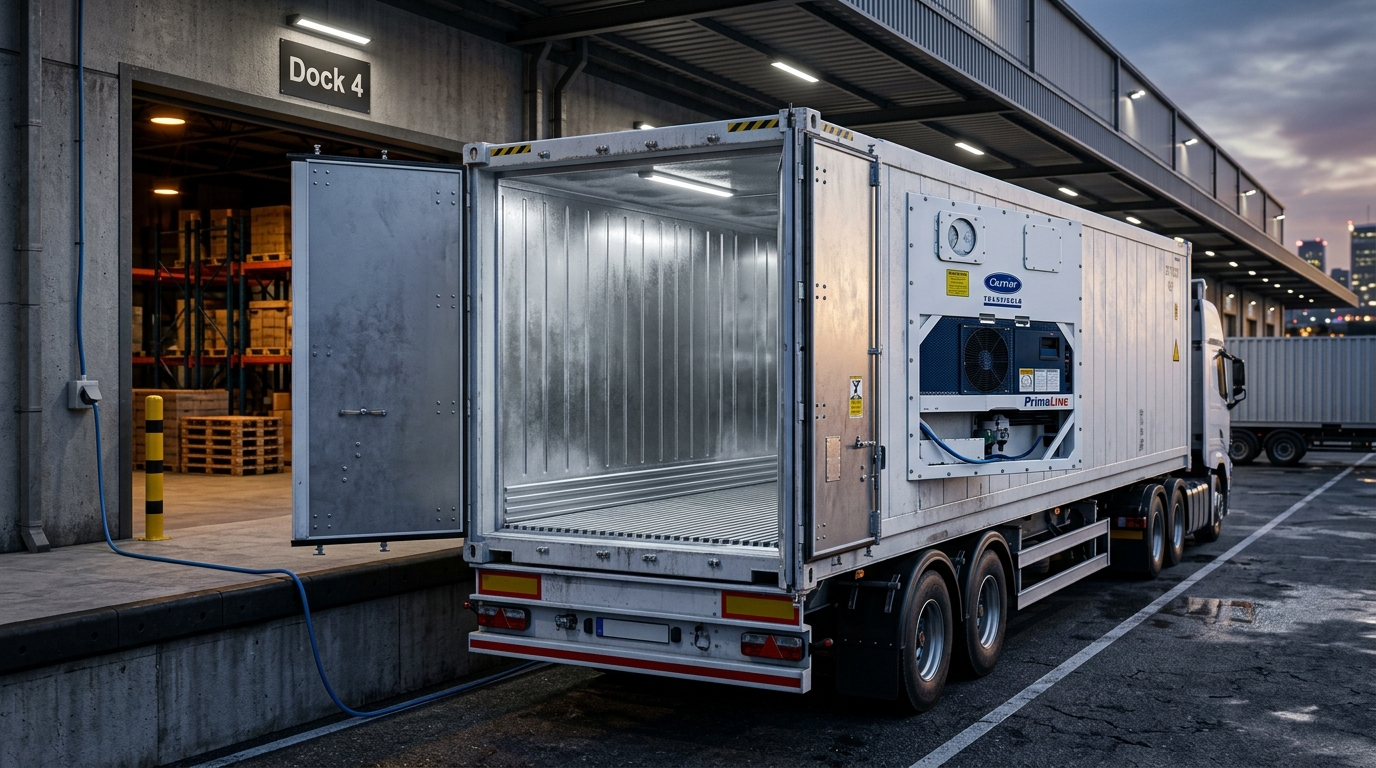
Key Technical Specifications (Dual Metric & Imperial)
The 20′ Standard Reefer container is engineered to rigorous ISO standards for specialized cargo logistics. The following technical parameters represent the validated engineering profile for 20RF in CBM3:
| Specification Parameter | Metric (ISO Standard) | Imperial (US Standard) |
|---|---|---|
| Equipment Code & ISO Type | 20RF (20ft ISO Thermal / Reefer Container) | ISO 1496-2 Standard |
| Internal Usable Length | 544.0 cm | 17 ft 10.2 in |
| Internal Usable Width | 227.0 cm | 7 ft 5.4 in |
| Internal Usable Height (to airflow line) | 224.0 cm | 7 ft 4.2 in |
| Rear Door Clearance (W × H) | 226.0 × 221.0 cm | 89.0 × 87.0 in |
| Usable Internal Volume | 27.7 m³ (CBM) | 978 cu ft |
| Maximum Gross Mass (MGM) | 30,480 kg | 67,197 lbs |
| Tare Weight (including cooling machinery) | 3,080 kg | 6,790 lbs |
| Maximum Net Cargo Payload | 27,400 kg | 60,407 lbs |
| Euro Pallets (1200×800 mm / EUR 1) | 9–10 pallets on floor (18–20 double-stacked) | |
| Standard GMA Pallets (48×40 in / 1219×1016 mm) | 8 pallets on floor (16 double-stacked) | |
| Temperature Operating Range | -30°C to +30°C (-22°F to +86°F) micro-climate regulation | |
Cold Chain Logistics, Pallet Loading & Airflow Dynamics
Loading refrigerated cargo requires strict adherence to aerodynamic and thermal principles that differ fundamentally from dry freight. In a standard dry container, packing cargo tight against all six walls maximizes space utilization. In a refrigerated container (20RF), doing so obstructs cold air circulation, causing thermal breakdown and cargo spoilage.
Reefer containers operate on a bottom-air delivery system: the refrigeration evaporator forces chilled air downward into the longitudinal aluminum T-bar floor. This chilled air travels under the cargo and rises vertically through ventilation holes in boxes or gaps between pallets, absorbing metabolic heat from perishables before flowing across the ceiling back to the cooling return bulkhead. Shippers must observe two essential rules:
1. Do Not Block the T-Floor: The floor area must be covered completely. If cargo does not fill the entire floor, the open floor space must be covered with cardboard or filler boards (false floor) to prevent short-circuiting, where cold air escapes through empty spaces rather than flowing up through cargo.
2. Respect the Red Airflow Ceiling Line: Every reefer features a red line marked on the interior side walls roughly 12 to 15 cm below the ceiling. Stacking cargo above this line blocks the return air path, creating hot pockets and catastrophic temperature deviations.
Interactive 3D Cargo Load Simulation
Verify your precise carton configuration, pallet patterns, airflow clearances, and gross axle weights before shipping. Use our free 20 reefer loading calculator to generate interactive 3D container stuffing diagrams and maximize usable volume.
Thermal Insulation & Refrigeration Machinery Architecture
The 20RF container is built with high-density polyurethane sandwich panel insulation encased between stainless steel or aluminum interior lining and exterior Corten steel or treated aluminum sheeting. The refrigeration machinery unit (Carrier Transicold, Thermo King, Daikin, or Star Cool) is permanently recessed into the front wall bulkhead. Because the refrigeration compressor, condenser, evaporator fans, and micro-processor controllers occupy approximately 45 cm (18 inches) of internal nose length, the usable interior length of a reefer is shorter than that of an equivalent dry container (e.g., 544 cm for 20RF vs 589 cm for 20DC; 1,156 cm for 40RF vs 1,203 cm for 40DC). CBM3’s 3D load planning engine models this machinery bulkhead accurately, ensuring your digital packing plan matches the physical reality.
Weight Distribution, Axle Limits & Transport Safety
Because the refrigeration machinery adds significant weight to the nose of the container (reefer tare weights range from 3,080 kg to 4,800 kg), longitudinal weight distribution requires careful management. Concentrating dense cargo toward the front can cause steering or drive axle overloads on drayage trucks, while placing excessive weight at the rear causes dangerous sway. High-density cargo should be balanced over the container’s center of gravity. Furthermore, heavy-duty lashing rings embedded in the bottom side rails (rated at 1,000 kg each) must be used with polyester ratchet straps and friction mats to prevent cargo movement during high-seas pitch and roll.
How to Plan a 20′ Standard Reefer (20RF) Load in CBM3 (Step-by-Step UI Guide)
Planning your 20′ Standard Reefer shipment is fast, intuitive, and 100% free with no registration required on CBM3. Follow these simple steps in the interactive calculator interface:- Select Equipment Profile: In the “Load Space & Units” control card, click the Load Space dropdown (or type in the instant search box) and select 20RF — 20′ Standard Reefer under the Sea Containers group. CBM3 instantly locks the precise usable dimensions, door clearances, and payload thresholds.
- Choose Your Measurement Units: Toggle seamlessly between Metric (cm / kg) and Imperial (inches / lbs) to match your commercial invoice and packing list.
- Input Cargo Dimensions & Quantities: Add individual package items or choose standard pallet presets (EUR 1, EUR 2, GMA/US Pallet). Enter length, width, height, unit weight, and total pieces.
- Configure Stacking & Orientation Rules: Set rotation allowances (e.g. “Keep Upright” for crated equipment or liquid bottles) and maximum allowable stacking layers or load limits. For reefer loads, ensure your cargo height does not exceed the red ceiling airflow line.
- Run 3D Stuffing Simulation: Click “Calculate” to instantly generate the interactive 3D cargo arrangement. Rotate 360°, inspect layer-by-layer packing sequence, view center of gravity, and check axle load distribution.
- Export Packing Manifest & Visuals: Download professional PDF or Excel loading reports containing full packing manifests and 3D visual diagrams to share directly with warehouse loaders and freight forwarders.
6 Costly 20′ Standard Reefer Load Planning Mistakes to Avoid
- Breaching the Red Airflow Ceiling Line: Stacking cartons to the roof blocks return air circulation, suffocating cargo and leading to catastrophic spoilage claims.
- Loading Warm, Non-Pre-Cooled Cargo: Reefer containers are designed to hold temperature, not cool down warm product. Stuffing warm cargo causes evaporator icing and thermal failure.
- Leaving Open Floor Channels Without Dunnage: Uncovered floor sections cause cold air bypass, starving cargo of refrigerated airflow. Cover exposed T-floor with cardboard.
- Assuming Dry Container Internal Dimensions: Reefer wall insulation and front machinery reduce length by ~45 cm and width by ~10 cm compared to standard dry containers.
- Ignoring Tare Weight in Highway Limits: The integrated refrigeration unit increases tare weight to 3,080–4,800 kg. Dense cargo reaches gross road weight limits much faster.
- Improper Box Ventilation Alignment: When shipping fresh produce, carton vent holes must align vertically with pallet apertures and floor T-bars for heat dissipation.
Related Equipment Loading Guides & 3D Planners
Compare specifications, pallet stacking efficiency, and dimensional constraints with related logistics equipment:
- 20′ Standard Reefer (20RF) Loading Guide & Calculator — 27.7 m³ volume, 9-10 Euro pallets, cold chain perishable logistics
- 40′ Standard Reefer (40RF) Loading Guide & Calculator — 59.5 m³ volume, 20-21 Euro pallets, global ocean reefer shipping
- 40′ High Cube Reefer (40RHC) Loading Guide & Calculator — 64.4 m³ volume, extra 30 cm vertical clearance, high-volume chilled cargo
- 20′ Open Top (20OT) Loading Guide & Calculator — 32.9 m³ volume, 5.48m crane roof opening, heavy machinery & marble
- 40′ Open Top (40OT) Loading Guide & Calculator — 66.4 m³ volume, 11.57m crane roof opening, long industrial components
- All Loading Space Guides & Equipment Directory — Full catalog of dry, reefer, open top, flat rack, trailer & intermodal specs
Frequently Asked Questions (FAQ)
How many pallets fit in a 20' Standard Reefer container?
A 20' Standard Reefer (20RF) fits 9 to 10 Euro pallets (1200×800 mm) or 8 standard GMA pallets (48×40 in) on a single floor layer. Pallet count is lower than dry containers because the cooling machinery bulkhead occupies approximately 45 cm (18 in) of internal length.
What are the internal dimensions of a 20RF reefer container?
The internal usable dimensions are 544 cm (17 ft 10.2 in) length, 227 cm (7 ft 5.4 in) width, and 224 cm (7 ft 4.2 in) height to the maximum airflow ceiling line, providing an internal cargo volume of approximately 27.7 to 28.1 m³ (978 to 992 cu ft).
What is the maximum cargo payload weight for a 20' Standard Reefer?
The maximum net cargo payload is 27,400 kg (60,407 lbs) against a Maximum Gross Mass (MGM) of 30,480 kg (67,197 lbs), with a tare weight of approximately 3,080 kg.
Why must cargo in a reefer container not exceed the red ceiling line?
Reefer containers circulate conditioned air from the bottom T-floor upwards through cargo and back across the ceiling to the cooling unit. Loading above the red load line blocks return airflow, causing severe thermal hot spots and temperature deviations that spoil perishables.