
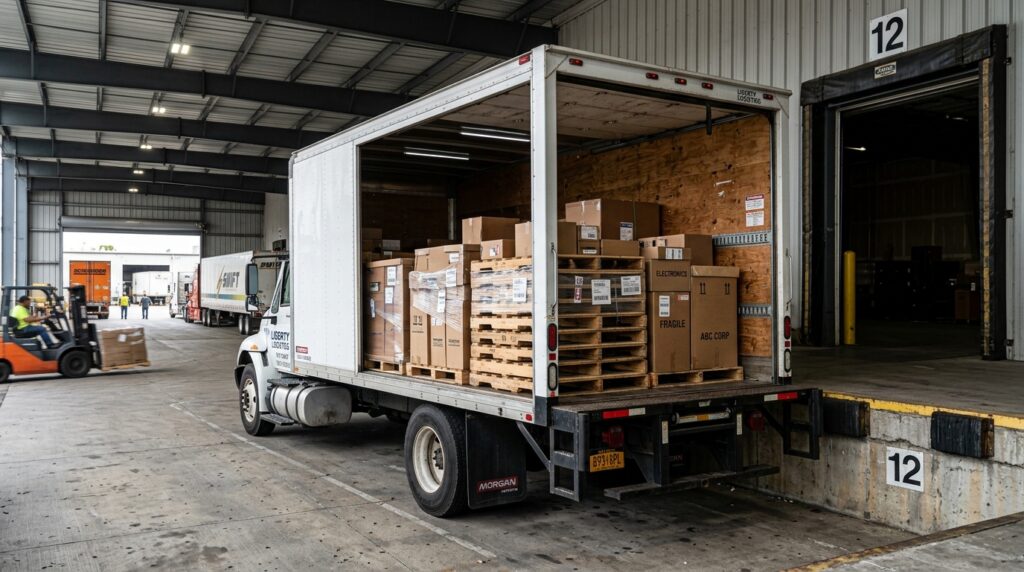
Quick Answer: The 26 ft North American Dry Freight Body (Equipment Code: BOX26_MORGAN) is North America’s premier medium-duty freight delivery platform, mounted on Class 6 and 7 straight truck chassis (Freightliner M2, International MV, Hino). It provides an internal usable envelope of 791.2 cm L × 249.9 cm W × 246.7 cm H (25′ 11.5″ L × 8′ 2.4″ W × 8′ 1.1″ H) with an internal volume of 48.8 m³ (1,722 cu ft) and a typical net cargo payload of 6,350 kg (14,000 lbs).
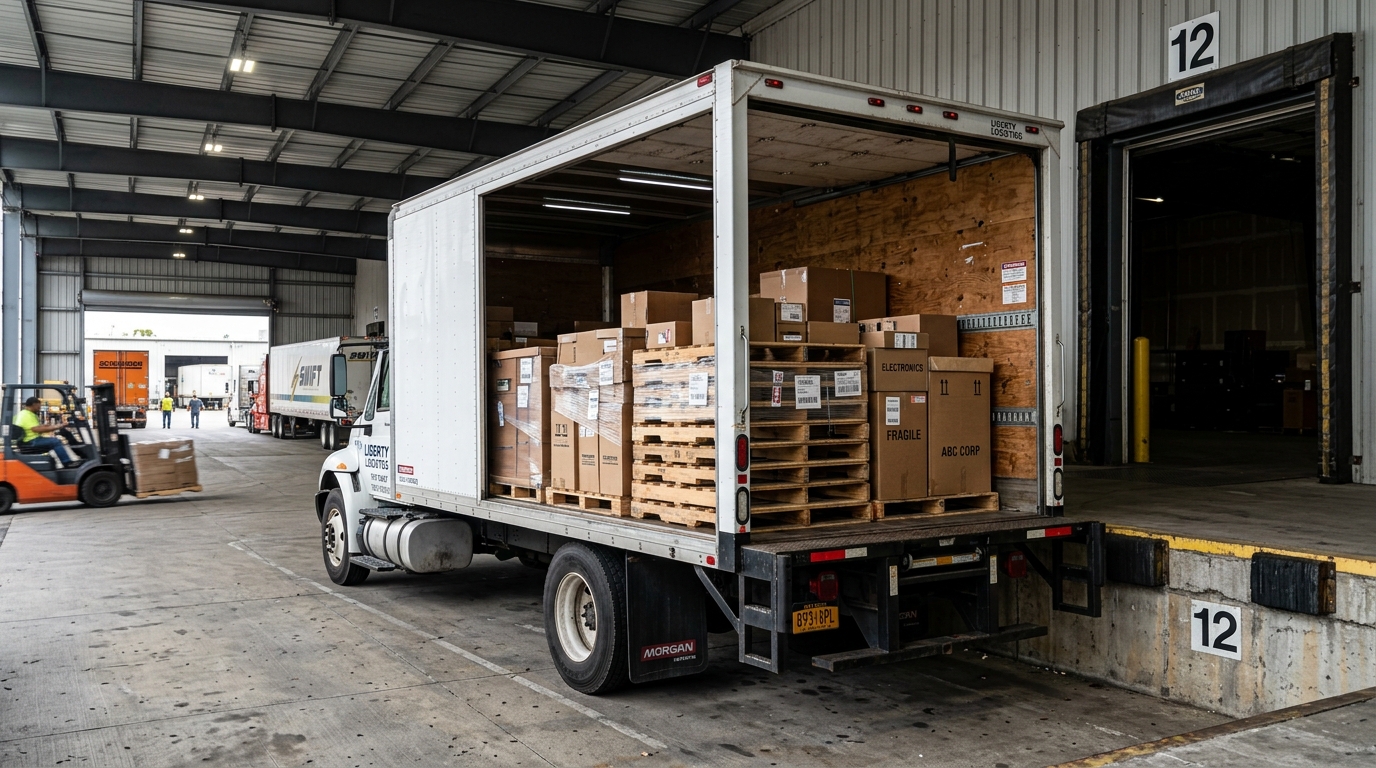
Key Technical Specifications (Dual Metric & Imperial)
The 26 ft North American Dry Freight Body is engineered to rigorous transport standards for specialized freight planning. The following technical parameters represent the validated engineering profile for BOX26_MORGAN in CBM3:
| Specification Parameter | Metric (Standard) | Imperial (US / UK) |
|---|---|---|
| Equipment Code & Profile | BOX26_MORGAN (Straight Trucks & City Delivery) | 26 ft North American Dry Freight Body |
| Internal Usable Length | 791.2 cm L × 249.9 cm W × 246.7 cm H | 25′ 11.5″ L × 8′ 2.4″ W × 8′ 1.1″ H |
| Door / Access Opening | 238.8 × 231.8 cm | 94.0 × 91.3 in |
| Usable Cargo Volume / Area | 48.8 m³ | 1,722 cu ft |
| Maximum Gross Mass (MGM) | 11,793 kg (26,000 lbs GVWR non-CDL class) | 26,000 lbs Class 6 GVWR |
| Tare Weight | 5,443 kg (chassis + body) | 12,000 lbs |
| Maximum Net Cargo Payload | 6,350 kg (14,000 lbs max legal) | 14,000 lbs |
| Euro Pallets (1200×800 mm / EUR 1) | 16 Euro pallets (1200×800 mm) | |
| Standard GMA Pallets (48×40 in / 1219×1016 mm) | 12–14 GMA pallets (48×40 in) on floor | |
| Rear Door Type | Roll-up overhead door with rear step bumper & tuck-under liftgate | Standard commercial roll-up door |
Freight Loading Efficiency, Pallet Patterns & Axle Load Optimization
Maximizing cargo density while ensuring full compliance with road vehicle gross weight ratings is the core objective of modern transport planning. In highway and intermodal logistics, cubic capacity and legal axle limits must be balanced simultaneously.
To achieve optimal payload performance:
1. Pinwheel & Turned Pallet Loading: In standard North American and European highway trailers, alternating pallet orientations (pinwheeling) eliminates lateral play, increases floor pallet count, and prevents pallet tipping during cornering.
2. Axle Weight Compliance: Federal bridge formulas and European Directive 96/53/EC enforce strict limits on steering, drive, and trailer axles. Heavy cargo must be stowed forward of the trailer tandems to distribute weight proportionally to the tractor drive axles.
3. Cargo Blocking & Dunnage: Gaps between pallets must be secured using corrugated dunnage boards, void fillers, or friction mats to prevent longitudinal cargo surges during sudden emergency braking.
Interactive 3D Cargo Load Simulation
Verify your precise carton configuration, pallet patterns, load center of gravity, and gross axle weights before shipping. Use our free 26 ft dry freight body calculator to generate interactive 3D container stuffing diagrams and maximize usable volume.
Structural Engineering, Tare Weight & Transport Standards
Every transport envelope profile modeled in CBM3 undergoes rigorous dimensional verification against physical manufacturing tolerances and regulatory standards. For BOX26_MORGAN, structural rigidity, corner casting tolerances, and flooring materials are engineered to withstand maximum gross dynamic loads during international transit.
When planning multi-tiered freight arrangements, engineers must account for carton compression strength and floor crossmember spacing. High concentrated loads should always be braced with timber dunnage to spread the pressure evenly across the longitudinal chassis sills.
How to Plan a 26 ft Dry Freight Body (BOX26_MORGAN) Load in CBM3 (Step-by-Step UI Guide)
Planning your 26 ft North American Dry Freight Body shipment is fast, intuitive, and 100% free with no registration or credit card required on CBM3. Follow these simple steps in the interactive calculator interface:
- Select Equipment Profile: In the “Load Space & Units” control card, click the Load Space dropdown (or type in the instant search box) and select BOX26_MORGAN — 26 ft North American Dry Freight Body under the equipment catalog. CBM3 instantly locks the precise usable dimensions, access clearances, and payload thresholds.
- Choose Your Measurement Units: Toggle seamlessly between Metric (cm / kg) and Imperial (inches / lbs) to match your commercial packing list and bill of lading.
- Input Cargo Dimensions & Quantities: Add individual package items or choose standard pallet presets (EUR 1, EUR 2, GMA/US Pallet). Enter length, width, height, unit weight, and total pieces.
- Configure Stacking & Orientation Rules: Set rotation allowances (e.g. “Keep Upright” for crated equipment or fragile cartons) and maximum allowable stacking layers or load limits to prevent cargo crushing.
- Run 3D Stuffing Simulation: Click “Calculate” to instantly generate the interactive 3D cargo arrangement. Rotate 360°, inspect layer-by-layer packing sequence, view center of gravity, and check axle load distribution.
- Export Packing Manifest & Visuals: Download professional PDF or Excel loading reports containing full packing manifests and 3D visual diagrams to share directly with warehouse loaders and freight forwarders.
6 Costly 26 ft Dry Freight Body Load Planning Mistakes to Avoid
- Overloading legal axle li: Overloading legal axle limits by failing to center dense freight over the suspension chassis.
- Ignoring door or roof ope: Ignoring door or roof opening clearances and attempting to stuff cargo that matches internal width but exceeds entry dimensions.
- Omitting friction rubber : Omitting friction rubber mats beneath heavy machinery, leading to metal-on-wood or metal-on-steel sliding during transit.
- Failing to account for ta: Failing to account for tare weight variations when calculating maximum cargo payloads near legal gross weight ceilings.
- Improper strap angle geometry: Improper strap angle geometry: securing straps at shallow horizontal angles drastically reduces downward clamping force.
- Overlooking destination c: Overlooking destination customs and offloading crane capabilities before booking specialized transport equipment.
Related Equipment Loading Guides & 3D Planners
Compare specifications, pallet stacking efficiency, and dimensional constraints with related logistics equipment:
- 20′ Dry Container (20DC) Loading Guide — 33.2 m³ volume, 11 Euro pallets, standard ocean shipping workhorse
- 40′ High Cube (40HC) Loading Guide & Calculator — 76.4 m³ volume, 25 Euro pallets, high-volume maritime freight
- 53′ Dry Van Trailer Loading Guide & Calculator — 111.8 m³ volume, 26–30 GMA pallets, North American highway standard
- 20′ High Cube Palletwide Loading Guide & Calculator — 38.6 m³ volume, 15 Euro pallets, European short-sea logistics
- 20′ Open Top (20OT) Loading Guide & Calculator — 32.9 m³ volume, 5.48m crane roof opening, heavy machinery & marble
- All Loading Space Guides & Equipment Directory — Full catalog of dry, reefer, open top, flat rack, trailer & air cargo ULD specs
Frequently Asked Questions (FAQ)
How many standard pallets fit in a 26 ft box truck?
A 26 ft dry freight body fits 12 standard GMA pallets (48×40 in) straight in two rows of 6, or up to 14 pallets when turned or pinwheeled. If pallets are stackable and within gross vehicle weight ratings, it accommodates up to 24–28 pallets.
What are the internal dimensions of a Morgan 26 ft dry freight body?
The internal usable planning dimensions are 791.2 cm (25 ft 11.5 in) length, 249.9 cm (8 ft 2.4 in / 98.4 in) width, and 246.7 cm (8 ft 1.1 in / 97.1 in) height, with a rear roll-up door opening of 238.8 cm width by 231.8 cm height.
Do you need a CDL to drive a 26 ft straight box truck?
Most 26 ft straight box trucks are rated at 25,999 lbs Gross Vehicle Weight Rating (GVWR), intentionally keeping them just below the 26,001 lb federal threshold so non-CDL drivers can operate them legally in regional delivery operations.
What is the maximum cargo payload for a 26-foot dry freight body?
Typical net payload capacity ranges between 10,000 and 14,000 lbs (4,535 to 6,350 kg), depending on whether the truck chassis is equipped with a heavy hydraulic liftgate, extra fuel tanks, or reinforced aluminum scuff liners.