
20ft Reefer Container Loading Calculator
Test the 20RF refrigerated-container profile with your shipment. Keep the carrier-required airflow channels and load line clear; the 3D arrangement is not a refrigeration assessment.
Test the quantity you enter and review placed and unplaced cargo. This is a planning estimate, not a maximum-capacity guarantee or transport approval.
A 20ft reefer cargo calculator checks your entered order, not the condition of a refrigerated shipment. This 20RF planning envelope is 544 x 227 x 224 cm, about 27.661 m3, with a 27,400 kg cargo limit. Use complete packed dimensions and upright permissions. Interior volume, doorway access and refrigerated loading marks are different checks.
Open the 20RF loading planner. Start a new job and confirm the equipment. This initial selection does not start a calculation; an existing saved job or your own selection takes priority.
Planning profile and supplier reference
| Field | CBM3 11.63.55 profile | Seaco 20ft Carrier PrimeLine |
|---|---|---|
| Length x width x height (cm) | 544 x 227 x 224 | 545.4 x 228.4 x 226.3 |
| Door width x height (cm) | Not supplied | 229 x 229.1 |
| Cargo access height (cm) | Not supplied | 222 |
| Cargo payload (kg) | 27,400 | 27,600 |
| Tare including machinery (kg) | Not supplied | 2,880 |
| Maximum gross mass (kg) | Not supplied | 30,480 |
| Volume (m3) | 27.661 rectangular envelope | 28.2 published nominal |
The Seaco June 2025 reefer brochure gives specific fleet examples on PDF page 3 (printed pages 3-4), not universal dimensions. The supplier figures above come from one Carrier PrimeLine column; do not mix machinery variants or replace the current CBM3 payload with them. Missing profile values do not mean a check passed.
The current product record marks this profile for source review. CBM3 uses a rectangular envelope; it has no separate machinery-bulkhead or reefer-airflow geometry in this profile. Its dimensions are not a certification of the real container.
A small volume can still be too tall
The 20RF planning height is 224 cm. A 230 cm-high package kept upright exceeds it, even though its 0.552 m3 volume is small. The supplier table above also distinguishes interior height, door opening and cargo access height; these are not interchangeable measurements.
Reproduce two geometric tests
Use metric units, palletization off, Horizontal Only rotation, no global rules, Normal priority and no delivery stop. Fragile is off and no extra maximum stack-weight limit is supplied. These synthetic boxes are geometry examples, not recommended refrigerated cargo patterns.
| Example | Width x length x height (cm) | Entered units | kg per unit | Input volume m3 | Stackable | This Side Up |
|---|---|---|---|---|---|---|
| A: cartons | 40 x 60 x 80 | 40 | 25 | 7.680 | Yes | No |
| B: upright height test | 40 x 60 x 230 | 1 | 100 | 0.552 | No | Yes |
| Example | Method | Entered | Placed | Unplaced | Allocated containers | Placed volume m3 | Placed mass kg |
|---|---|---|---|---|---|---|---|
| A | Max Volume | 40 | 40 | 0 | 1 | 7.680 | 1,000 |
| A | Best Balance | 40 | 40 | 0 | 1 | 7.680 | 1,000 |
| B | Max Volume | 1 | 0 | 1 | 0 | 0.000 | 0 |
| B | Best Balance | 1 | 0 | 1 | 0 | 0.000 | 0 |
Example B completes with one unplaced item because its upright height exceeds the profile. Zero allocated containers does not mean zero containers are needed: no valid placement was found for that item. The B input remains 0.552 m3 and 100 kg whether it is placed or not. Do not turn a required upright package sideways just to obtain a passing result.
Recorded on 6 October 2026 using the installed 11.63.52 Worker in Node. Independent checks cover counts, orientation, bounds, overlap, support and payload. This is not a real-browser, thermal, airflow or physical-loading acceptance test, and does not establish maximum capacity.
Before arranging refrigerated transport
Hapag-Lloyd’s reefer cargo-handling guidance addresses product preparation, packaging, loading marks, floor/air distribution and operating settings. Follow the instructions for your booked equipment and commodity. CBM3 does not assess those thermal or airflow requirements.
- Confirm the real container, cargo access and permitted loading marks with the responsible operator. A published interior dimension is not a loading-path check.
- Enter complete package or loaded-pallet outer dimensions, total height and gross unit weight. Include a base only once; keep loaded pallets upright and stacking off unless the complete unit is suitable.
- Review every placed and unplaced quantity. Ask the loading team to assess access, circulation, distribution and securing before using a geometric arrangement.
- Verify shipment mass and road equipment separately. Example cargo mass is not VGM, an axle-load approval or a cold-chain certificate.
Related planning guidance
Compare 40ft standard reefer loading guide and 40ft high cube reefer loading guide. Use the step-by-step planning guide for the workflow, or return to the loading-space guide directory.
Measure Refrigerated Cartons or Complete Loaded Pallets
Record the outside size of each packed unit, including wrapping and overhang. Keep different sizes and handling permissions in separate rows. A complete loaded pallet’s height and gross unit weight include its base once; keep it upright, allow horizontal turning only, and leave stacking off unless the complete unit is suitable. Do not enable palletization again for an already built pallet. The current rectangular profile has no separate machinery or airflow map.
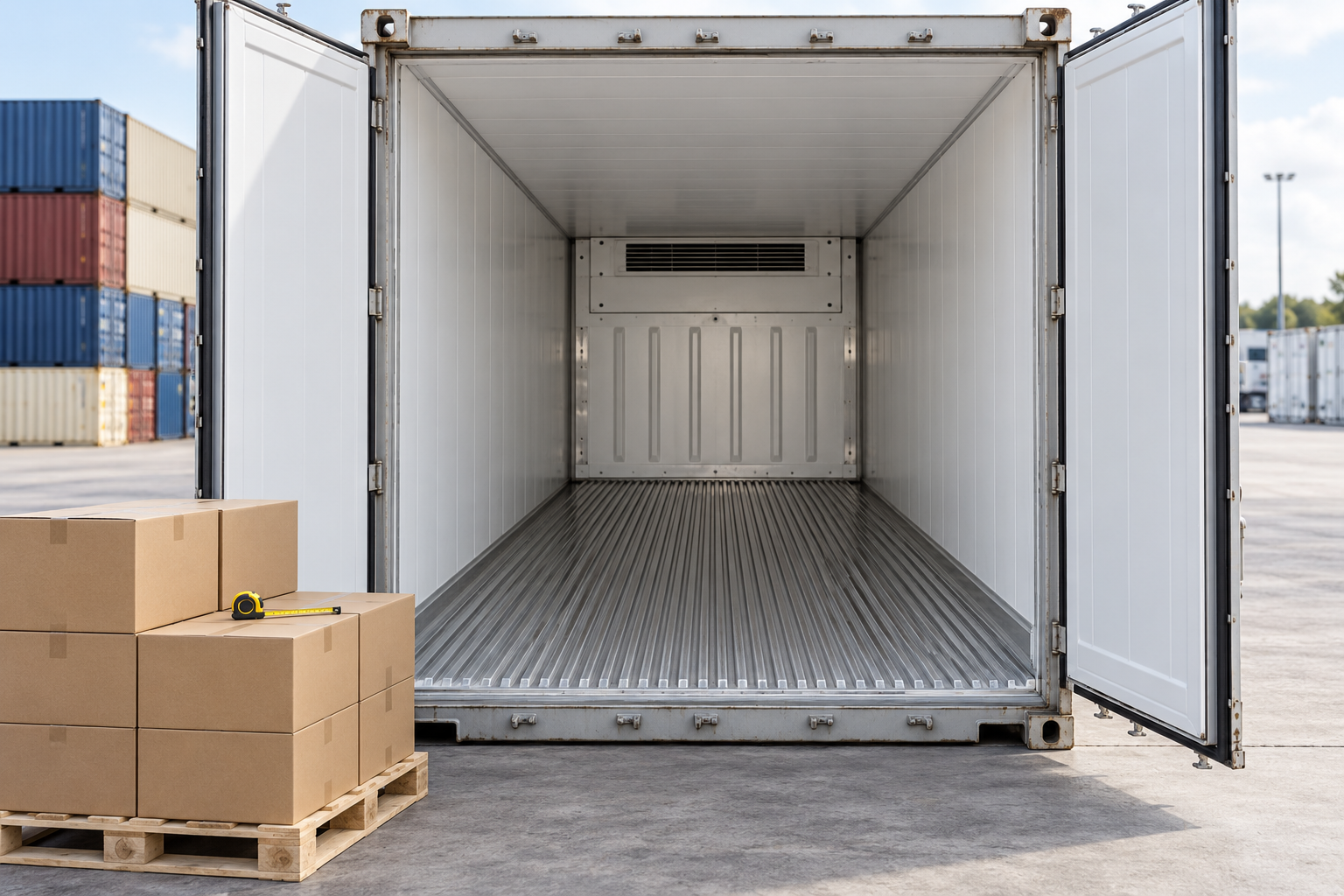
Calculate cargo CBM from centimetres as width x length x height x quantity / 1,000,000. The recorded carton order is 40 x 60 x 80 x 40 / 1,000,000 = 7.680 m3 and 40 x 25 = 1,000 kg. These figures describe the entered order, not a maximum box count, a temperature assessment or VGM. The illustrated cartons outside the container are not the recorded test shipment.
20ft Reefer Loading Questions
How many cartons fit in a 20ft reefer?
There is no single count without packed dimensions, quantity and handling rules. Test the actual order, then reconcile entered, placed and unplaced units. The recorded example places forty cartons; it does not calculate the maximum number of cartons the equipment can hold.
Why does a small 0.552 m3 package remain unplaced?
Its required upright height is 230 cm, above this profile’s 224 cm height. A small volume does not overcome a dimension constraint. Keep This Side Up and the actual rotation permission; turning an upright-only package sideways is not a valid remedy.
Does zero allocated containers mean no container is needed?
No. In this rejected-height example, neither automatic method places the one entered item. Its input quantity, 0.552 m3 and 100 kg still exist even when placed volume is zero. Review suitable equipment or the actual packaging with the responsible team.
Can I use a dry 20ft container’s dimensions or pallet count?
Do not substitute a different profile or a reference pallet count. Confirm the actual refrigerated unit and measure the full load. This profile is a planning rectangle, not evidence that its missing door, tare or loading-line data passed verification.
Does a fitted layout prove refrigeration is adequate?
No. Product preparation, packaging, load marks and circulation need an operator- and commodity-specific review. Hapag-Lloyd’s named handling guidance separates those matters from dimensions. CBM3 does not verify temperature, air distribution or cold-chain performance.
References and Check Dates
Named references: Seaco Standard and High Cube Reefers, June 2025 brochure, whose metric table was inspected 6 October 2026; Hapag-Lloyd Reefer Cargo Handling, read 7 October. The 11.63.55 planning-profile and unchanged-source compatibility check is dated 7 October. Recorded 11.63.52 engine results retain their 6 October date. No fresh brochure or physical-load inspection is claimed.
Software compatibility note, 8 October 2026 (Europe/Istanbul): The planning profiles and recorded example inputs were checked against the source-reviewed CBM3 11.63.56 candidate. The earlier example execution dates remain unchanged; this compatibility review is not a new optimization run or physical-loading test. Fleet-provider and carrier references are not manufacturer approval. Confirm the actual unit dimensions, payload and securing requirements.
How to inspect and hand over a loading plan
Use the selected plan and the complete shipment data. Recheck the result after changing cargo, equipment or handling rules.
See every cargo unit in context
Search the cargo inventory, focus on an item and switch between realistic, operational, top and side views. Inspect pallet layers and height sections.
The inventory separates requested units, units in the selected container, units in other containers and unplaced units. Select a row to find its cargo in the scene; playback and height sections show only part of the complete plan.
Use pallet details to inspect full, partial and mixed pallets. A height section filters the view; it does not remove cargo from the plan. Vehicle bodies and wheels provide visual context.
Prepare clearer warehouse instructions
Use product colors and short codes, named groups and delivery stops. Choose a summary or warehouse PDF for the selected plan.
Assign product colors and short codes to connect the cargo table, 3D view and reports. Group and stop names improve instructions; apply the appropriate loading rules when a sequence must be enforced.
Compare verified alternatives and review any manual moves. A manual reallocation affects the current preview and PDF; saved or shared inputs recalculate the automatic arrangement when reopened. Export again after changes.
Read the estimated center of gravity
Review longitudinal, lateral and height coordinates from known cargo and pallet masses. Check the displayed origin and units before comparing plans.
The estimate assumes each item's mass is centered and excludes vehicle tare. Missing or stale additional-material records can leave the complete-load assessment unavailable; explicitly declare none when no extra materials are present.
Coordinates use the load-space frame, not road height. For Step Deck, X starts at the raised front end and Y at the lower-deck datum; axle-form distances run from the rear toward the cab.
Distinguish the loading unit from its carrying vehicle
This loading unit alone does not define an axle configuration.
Inspect cargo and pallet weight distribution in this loading space. A container, swap body or air-cargo unit does not identify the road chassis, rail wagon or aircraft carrying it.
Axle estimates are available after selecting a supported complete road or rail vehicle. Enter its actual mounting positions, full empty reactions and applicable limits; do not reuse a trailer reference as container or aircraft approval.