
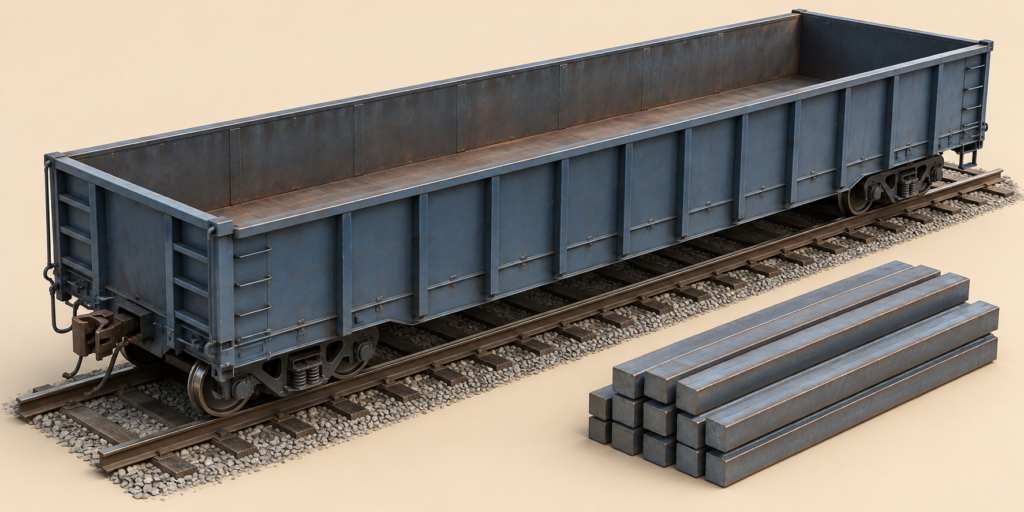
A 66 ft mill gondola is an open-top railcar for heavy freight, not an enclosed boxcar. TrinityRail identifies a 66 ft mill-gondola family for steel products and other heavy-duty applications. The family name alone does not establish the dimensions, tare or load limit of the car assigned to a shipment.
Reference scope: a current model-specific drawing matching every CBM3 Trinity profile field has not been verified. This guide therefore explains what to measure and confirm; it does not advertise a verified number of pallets, billets or tonnes for a supplied railcar.
Which gondola dimensions matter for cargo planning?
| Required information | Why it matters |
|---|---|
| Reporting marks, car number and applicable drawing | Identify the actual variant before transferring dimensions |
| Clear inside length and width | Determine usable floor space around structural features |
| Side height and permitted load envelope | Separate the body from the approved loaded outline |
| Tare, load limit and route restrictions | Keep cargo mass distinct from gross rail load |
| Floor, concentrated-load and securement requirements | A volume model does not establish structural suitability |
| Loading and unloading access | Confirm the handling operation, not only the final position |
What does the CBM3 Trinity profile mean?
CBM3 11.63.56 currently represents the cargo space as a 2,011.68 x 274.32 x 182.88 cm rectangular model. These are stored software values. They must not be presented as newly verified manufacturer dimensions, a usable opening or a guaranteed load envelope for every 66 ft gondola.
The current primary-source review confirms the product family, but not the exact variant behind all those numbers. Using another manufacturer’s 66 ft drawing to fill that gap would create a misleading match. Obtain the actual car specification before treating a simulation as a physical fit assessment.
Prepare a rail cargo list
- Record the outside dimensions and gross mass of each bundled or crated handling unit.
- Preserve orientation and stacking restrictions supplied with the goods. A steel shipment is not automatically safe to rotate or stack in any direction.
- List dunnage, spacers and handling clearances separately so they are not mistaken for free space.
- Compare the entered, placed and unplaced quantities in a preliminary model.
- Have the railway and loading operator confirm the actual car, loading method, distribution and securement before dispatch.
The CBM calculator can help assemble a dimensional cargo list. The 3D planner is a planning aid, not a substitute for rail loading instructions or structural checks.
Volume example and its limit
Eight rectangular bundles, each 400 x 50 x 50 cm, total 8 m3. That arithmetic does not say how much those bundles weigh or how their contact loads affect the floor. It also does not model a crane movement or validate how the bundles are restrained. No gondola capacity is inferred from this example.
Common 66 ft gondola questions
Can a boxcar load plan be reused in a gondola?
No. The equipment, access and handling assumptions differ. Review the supplied car and loading procedure rather than transferring a result just because the nominal lengths are similar.
Does an open top allow unlimited load height?
No. A missing roof is not an unlimited clearance allowance. The accepted loaded envelope and route must be confirmed independently.
Reference and review scope
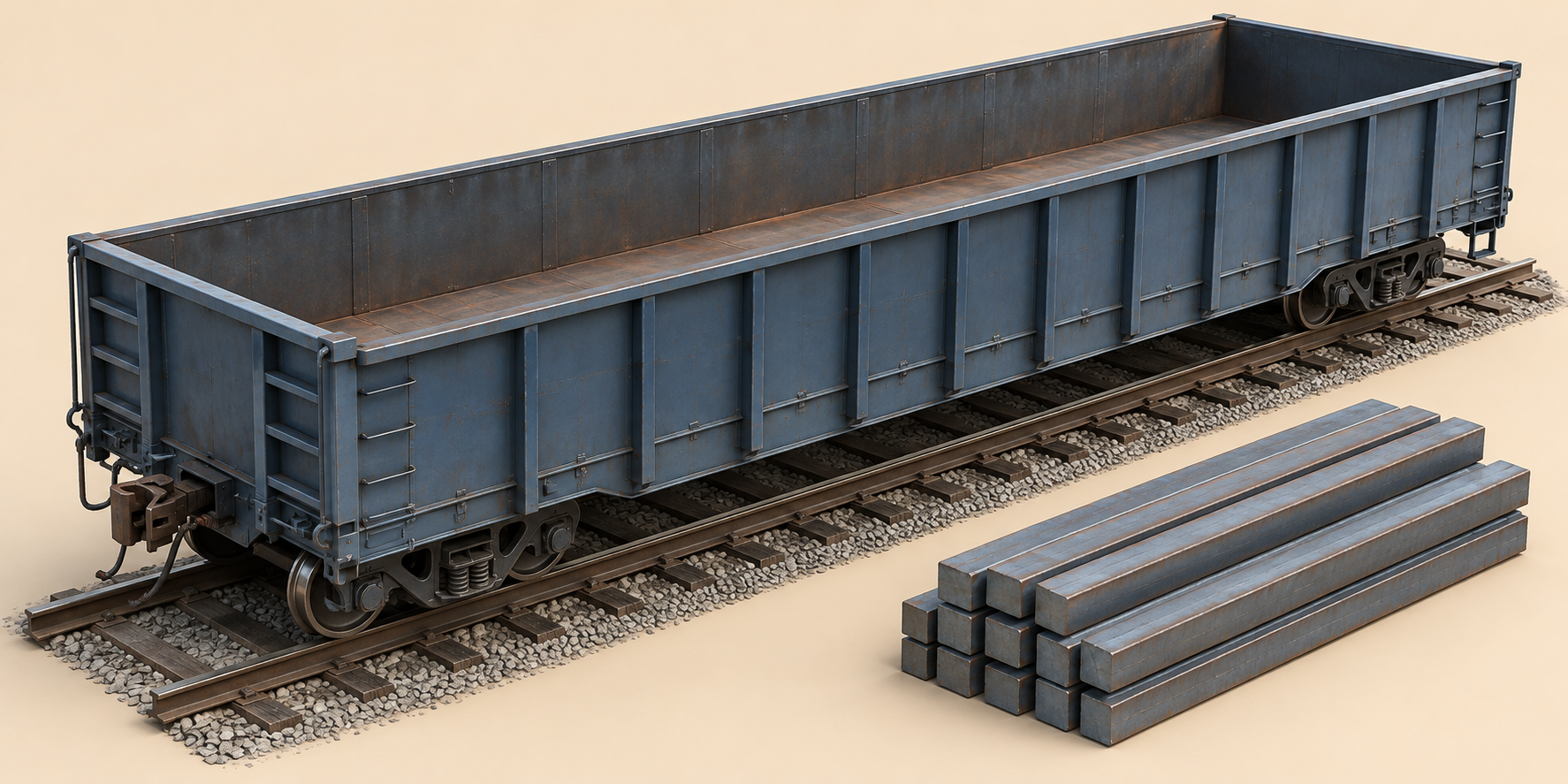
Named references: TrinityRail’s Gondolas product-family page and its October 2025 railcar overview, available in the manufacturer resource library. Checked on 9 October 2026. Neither was used to invent missing variant dimensions. The illustration is generic, AI-generated and not a TrinityRail engineering drawing. Browse the equipment guide directory for other planning references.