
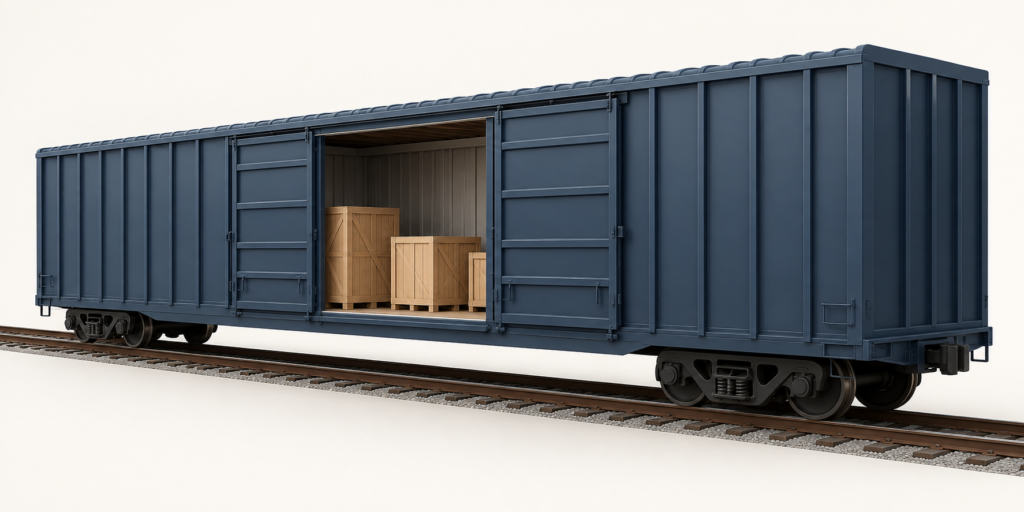
A 60 ft boxcar name is not enough to calculate cargo fit. Check its actual inside dimensions, side-door opening and load limit. This guide uses the BNSF 761000-761099 equipment sheet and the corresponding CBM3 planning profile, rather than combining dimensions from different 60 ft railcar models.
Open the BNSF 60 ft boxcar planner to test entered quantities. This is a static arrangement tool: it does not prove that a forklift can move, turn or place each unit through the side doorway.
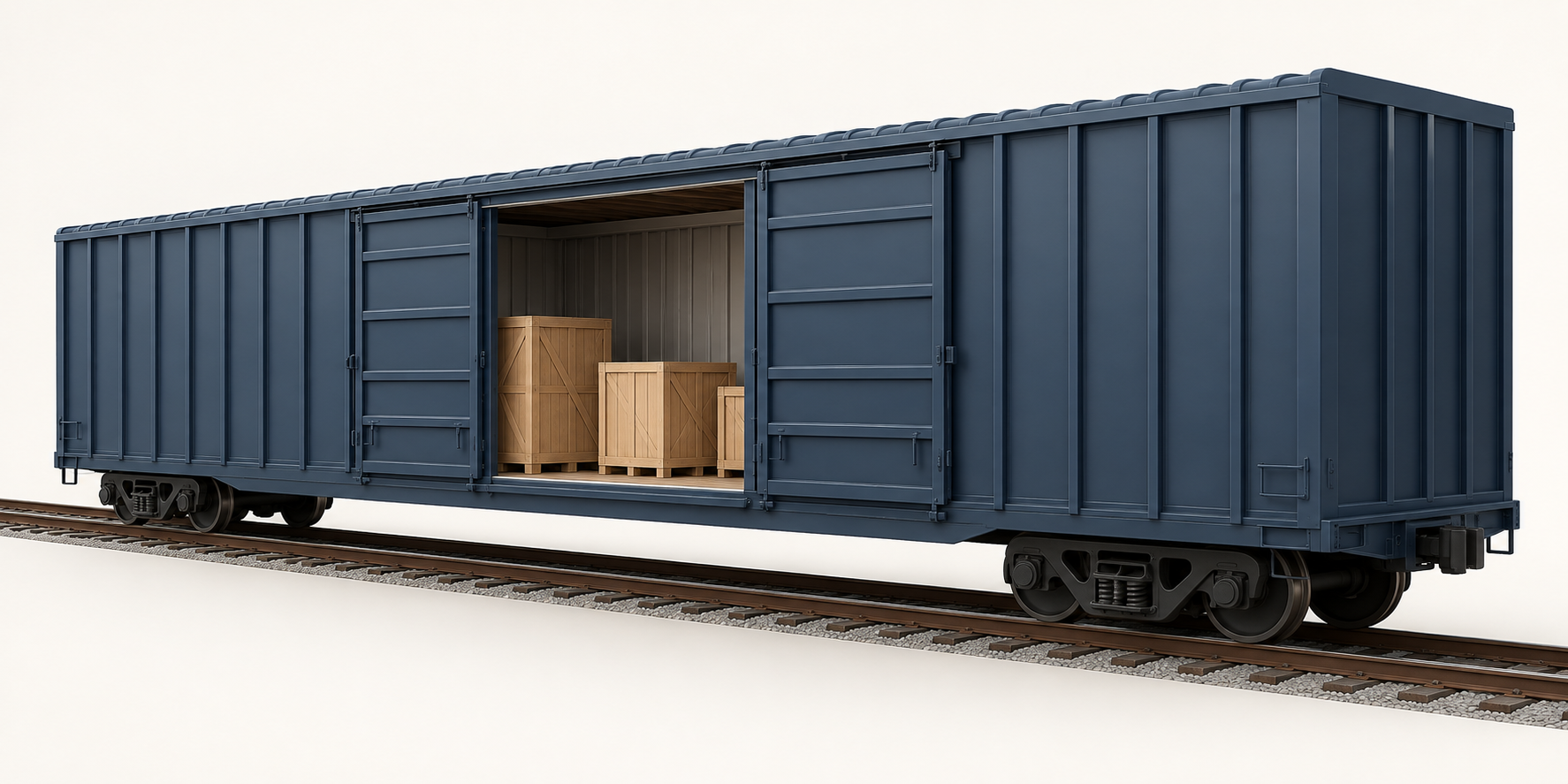
60 ft boxcar inside dimensions and door opening
The following reference applies to the identified BNSF series. Confirm the assigned car and current operating limits before planning an actual shipment.
| Measurement | BNSF 761000-761099 reference | CBM3 11.63.56 profile |
|---|---|---|
| Inside length | 60 ft 9 in | 1,851.66 cm |
| Inside width | 9 ft 6 in | 289.56 cm |
| Inside height | 13 ft 0.5 in | 397.51 cm |
| Clear side-door opening | 16 ft x 12 ft 4 in | 487.68 x 375.92 cm |
| Published volume | 7,526 cu ft | 213.11 m3 nominal |
| Load limit at 286,000 lb gross rail load | 201,200 lb | 91,263 kg cargo limit |
| Reference light weight | 84,800 lb | 38,465 kg |
The software’s metric masses are rounded catalogue values. The BNSF sheet also lists a different load limit at a lower gross rail load. Do not substitute a gross rail load for cargo payload or assume that every car with the same nominal length has this capacity.
Why side-door loading needs a separate check
A boxcar’s cargo is normally moved through a side opening, not through the end of a sea container. A package may fit inside the final rectangle but still be impossible to maneuver into that position with the available handling equipment. Door width alone does not establish the turning envelope.
- Confirm the clear opening and any threshold or doorway obstructions on the assigned car.
- Allow for forks, turning space, approach angle and the actual loading sequence.
- Have the responsible operator check floor and concentrated loads, load distribution, blocking and restraint.
- Keep operating restrictions separate from empty geometric space. The source’s stated loaded centre-of-gravity example has a lading-height condition; full interior height is not blanket loading approval.
Two entered-quantity examples
These are synthetic CBM3 11.63.56 standard-engine runs from 9 October 2026, Europe/Istanbul. They check quantities, rectangular boundaries, overlap, permitted orientation and mass. They do not validate side-door movement, floor loading, securing or rail operation.
Example 1: forty non-stackable units
Enter 40 units measuring 120 x 100 x 160 cm, each weighing 500 kg. Keep Horizontal Only and disable stacking. The recorded run placed 36 units in the first model space and 4 in a second, with no unplaced units. Cargo masses were 18,000 kg and 2,000 kg. This is the distribution found in that run, not proof that two cars are the mathematical minimum or an approved loading instruction.
Example 2: two carton sizes
Enter 20 cartons of 100 x 80 x 120 cm at 100 kg each and 30 cartons of 60 x 40 x 50 cm at 20 kg each. With Horizontal Only and stacking permitted, the recorded run placed all 50 units in one model space. Total cargo was 2,600 kg and 22.8 m3. Review actual carton strength before carrying over the example’s stacking permission.
Prepare a useful boxcar cargo list
- Identify the actual railcar series rather than selecting by length alone.
- Use packed dimensions, including any base, wrapping or protrusions.
- Enter each size and weight as a separate row; do not average mixed units.
- Preserve upright and non-stackable restrictions, even if they reduce the number placed.
- Review the quantity in every reported car, then hand the arrangement to the loading team for access and securement checks.
The CSV and Excel template guide explains the cargo columns. A spreadsheet is an input format, not an independent rail-loading approval. The multi-container guide explains quantity reconciliation, but its sea-container comparisons should not be used as a railcar booking recommendation.
Common questions
How many pallets fit in a 60 ft boxcar?
There is no reliable single count without the loaded pallet dimensions, permitted stacking, mass and handling route. Enter complete loaded units and test the actual quantity. A footprint-only count omits overhang, height and access.
Does all the published cubic capacity become usable cargo space?
No. Gaps, carton shapes, non-stackable cargo and handling clearances affect placement. Passing the software’s weight limit does not validate individual floor loads.
Named references and review
Technical reference: BNSF Railway, Box Car 60 FT, 286 GRL, series 761000-761099, page I139. Product reference: CBM3 11.63.56 equipment catalogue and recorded synthetic examples. Reviewed 9 October 2026. This guide is not a BNSF endorsement. Browse the equipment guide directory for other load-space types.