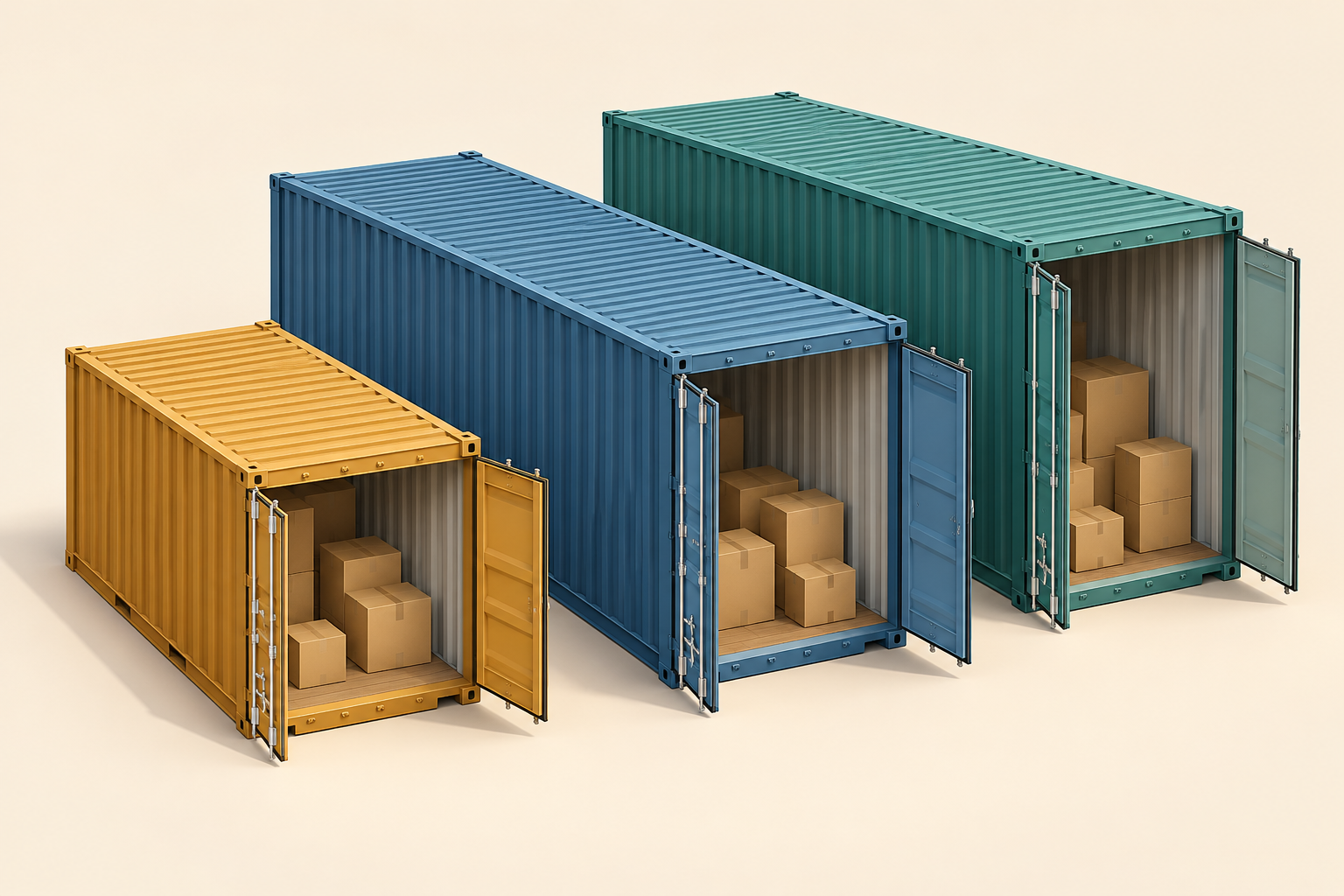
A 40ft standard container offers about twice the internal volume of a 20ft standard container. A 40ft high cube keeps the longer footprint and adds height. The useful choice depends on your packed cargo, permitted stacking, actual weight and door access. Enter the same shipment in all three profiles to see which produced plans place every ordered unit.
This comparison helps you choose equipment for freight cargo. Start with the shipment comparison tool, review the checked example, then confirm the assigned container and transport requirements with your carrier.
AI-generated explanatory illustration. The sizes are conceptual and not to scale; the cartons do not represent a verified loading result.
20ft vs 40ft vs High Cube: Main Differences
20ft standard: the shorter option. A compact order may use its space well, but a low CBM total alone does not prove that the packages fit.
40ft standard: more length and floor space. It can suit a larger floor-loaded order or more loaded pallet footprints; the longer container does not double its allowed cargo weight.
40ft high cube: more height than a standard 40ft container. Extra height can help tall cargo or allow another permitted layer. It does not add another row of pallets to the floor simply because the roof is higher.
In CBM3 these starting profiles are called 20DC, 40DC and 40HC. The values below are software planning inputs. They are separate from the measurements and limits of the individual container allocated to your booking.
CBM3 11.63.55 default rectangular planning profiles; dimensions are internal length x width x height.
Profile
Length (cm)
Width (cm)
Height (cm)
Calculated internal volume (m³)
Cargo-weight input (kg)
20DC
589
235
239
33.081
28,200
40DC
1203
235
239
67.566
28,600
40HC
1203
235
269
76.048
28,600
Internal volume here is calculated from the profile dimensions, rounded to three decimals. It is not a guaranteed cargo capacity. Gaps, package shapes, access and handling restrictions can leave some of that space unusable for your order.
Internal Size, Door Opening and Payload
Nominal 20ft or 40ft length is not the usable loading length. Check the inside measurements, then the opening through which each finished package must pass. A package can be shorter than the internal roof height and still be too tall for the door.
Published Hapag-Lloyd fleet examples checked on 6 October 2026; these are not universal specifications or CBM3 defaults.
Carrier example
Published capacity (m³)
Door width x height (mm)
Published payload (kg)
20ft standard
33.2
2340 x 2292
28,130
40ft standard
67.7
2340 x 2292
28,750
40ft high cube
76.3
2340 x 2597
28,600
The carrier identifies these as examples and notes manufacturer differences. Confirm the assigned unit’s measurements, tare, rated gross mass and payload. If its measured limits differ from the selected planning profile, enter the applicable equipment constraints before relying on the result.
Payload is the permitted cargo mass. Tare is the empty container mass; maximum gross mass covers the container and its contents. Include the packed goods and any pallets, dunnage or other loading materials in the appropriate cargo calculation. Also check the limits that apply to the actual transport route.
Compare One Unchanged Cargo List
Enter one row per packed size or SKU, including outside dimensions, quantity and unit weight. Use Horizontal Only unless the goods may genuinely be turned onto another face. Set stacking, fragile, load-bearing and other restrictions to match the finished cargo.
3D Container Loading Calculator & CBM CalculatorVERSION 11.63.56
Compare shipment equipment
Compare the same cargo and rules in 20DC, 40DC and 40HC using the existing placement engine.
Unsaved cargo changes. Save your calculation before leaving this page.
💾 Save Calculation
🔍 Load by Save Code
Enter the save code (e.g. CBM-ABC123) to load a saved calculation.
1 USD = 1.00 USD
⌨️ Shortcuts:Ctrl+N New RowCtrl+S SaveCtrl+Z UndoCtrl+Y RedoEnter Add Row (in last row)Tab Next Field
📚 Product Library 0 items▼
Products are added with quantity 1. New manual products use standard rules; save a cargo row to keep its loading rules.
No saved products yet. Save a row to build your library.
Use only for box-shaped units with flat rigid load-bearing faces in allowed orientations. Assumes a centered center of gravity; verifies static balance, not transport forces or crushing strength.
📥 Import from CSV / Excel
▼
Upload CSV, TSV or Excel. Use the template for units and loading rules. Length may be blank for cylinders. Invalid rows are shown before you choose what to import.
📤 Export Data
▼
Cargo CSV/XLSX does not include private CSC/VGM records. Transfer those separately in Private record files.
Export current table data together with the new loading constraints, plus calculation results such as volume, density and freight class.
Filename: CBM_Export_YYYY-MM-DD.csv/xlsx
🕒 Calculation History 0 records▼
Last 10 calculations are auto-saved. Click to reload.
No history yet. Calculations are automatically saved.
📋 Templates Saved templates: 0▼
Templates now keep product constraints such as pallet requirement, rotation mode, side-up rule, fragile flag, max stack, loading priority and drop-off stop.
No templates saved yet.
📁 My Records 0▼
Your saved calculations. Click to reload.
No saved calculations yet.
🚢 Load Space & Units
Load Space
No matching containers
Custom Container Dimensions
My Equipment
Open-deck profile settings
Enter the operating envelope for this equipment before planning.
Open-deck results are planning aids. Verify the actual vehicle, route, legal limits and cargo securement.
Global loading rulesWorkflow accelerator
Workflow accelerator
Industry loading presets
Apply proven starting rules, then adjust any row or plan rule to match the shipment.
Applies only the selected starting defaults. You can edit any value afterwards.
Equipment restrictions
My cargo dimensions do not include pallets
This ULD is already a container or aircraft pallet; nested palletization is disabled.
📦 Pallet ConfigurationShared shipment settings appear when a row uses pallets.
Row controls choose how each product uses pallets. These shared settings define the Auto Compare pool, shipment default height, groups and advanced stacking.
Check only profiles that Auto Compare may consider. A fixed row selection does not need a checkbox here.
Advanced profile assignment
Optional ordering behavior for Auto Compare. Fixed pallet choices are made in each cargo row.
Required specifications for generic pallets
Enter the real pallet deck height. Tare and cargo limit are optional; weight validation remains unverified when omitted.
Advanced loaded-pallet stacking
This is a user-supplied operating rule, not a pallet certificate. Full footprint support, a flat top and non-fragile stackable cargo are still required.
⚠️ Custom specs active — nominal values overridden
Dimensions: -
Volume:0.000m³
Converted: 0.000ft³
Override Specs (session only — resets on page reload)
Dimensions are approximate industry standards. Minor variations may occur depending on manufacturer and carrier.
🌍 Transport mode
Do you also want to calculate the freight cost?
🚢 Sea Freight Pricing
✈️ Air Freight Pricing
🚛 Road Freight Pricing
Rail Freight Pricing
Rail cost is calculated only from the carload quote you enter. Confirm operator, route and accessorial charges.
CBM3
Total Items
Set handling and route constraints for this cargo row.
Item Name
Width [cm]
x
Length [cm]
x
Height [cm]
Qty
Wt/pc [kg]
Total [kg]
Volume [m³]
Density (kg/m³)
Est. class
Actions
Number of rows to add: 1–100
📊 Summary
📦Total volume:
0.000m³
0.000ft³
Net Cargo Volume (Pallet Excluded)
0.000 m³
⚖️Cargo / pallet subtotal
0.0kg
0.0lb
Logistics & Freight
N/A
💰 Chargeable weight:0.0 kg
⚖️ Volumetric weight:0.0 kg
Estimated freight classN/A
Cargo/pallet subtotals and freight estimates exclude additional packing materials and equipment tare. They are not the complete loaded mass.
Total rows:0
Containers needed:0
Selected load spaceAutomatic
○
Ready for cargo dataAdd dimensions and quantities to calculate the loading plan.
0
Matched-set resultEqual Quantity FCL result
Matched sets0
Per SKU0
Total units0
This comparison requires standard floor-loaded cargo and the background planner. Pallet planning remains a separate workflow.
📦 Pallet Configuration
Pallets needed
0
Cargo / pallet subtotal
0kg
Cargo/pallet subtotals and freight estimates exclude additional packing materials and equipment tare. They are not the complete loaded mass.
Avg pallet fill
0%
Cargo area
—
📏 Loading Metres (LDM)
LDM:— / 13.6 m
0%
Floor positions: —
Cargo/pallet subtotals and freight estimates exclude additional packing materials and equipment tare. They are not the complete loaded mass.
✈️ Chargeable Weight
Actual Weight:—
Volumetric Weight:—
Chargeable Weight:—
ℹ️ Divisor:
🚚 Freight Class Info:
Estimate based on entered cargo density. Confirm the NMFC item, packaged dimensions, handling, stowability and liability requirements.
🚢
Shipping Recommendation
N/ASelect a container and add cargo to see recommendation
⭐ ⭐ Best Fit Container
Add cargo and select a sea container to see Best Fit recommendation.
💡 💡 Packing Optimizer
Add cargo data and select a container to see intelligent packing advice.
🌍 🌍 Transport Mode Comparison
Volumetric weight & cost comparison across all modes
💡 💡 Smart Insights
ℹ️ How it works: Chargeable weight = max(actual weight, volumetric weight). Carriers charge based on whichever is higher. Volumetric factors: Sea 1:1000, Air/IATA 1:167, Road 1:333. Enter a price above to see estimated freight costs.
3D visualization is not available for refrigerated containers.
🎮 🎮 3D Loading Simulation
View
Camera
0 / 0
Multi-container load planReview each container and any unplaced cargo separately.
ℹ️ Step Information
Item:—
Dimensions:—
Weight:—
Drop-off Stop:—
Alternative load plans
Compare loading plans
Choose the plan that best matches capacity, balance, or warehouse handling priorities.
3 scenarios
Your selection drives the summary, 3D view, PDF, saved record, and shared link.
Pareto Explorer
Compare non-dominated completed plans. This view never starts another solver.
Public plan handoffShare this loading planSend an editable plan link to your customer, warehouse or logistics team.
Loading method:
Transport Check
⚖️ Weight Distribution
Rear:—
Front:—
📊 Volume utilization
📦 Volume
0%
⚖️ Weight
0%
🧾 Create Quote / Request
Fill in your details to generate a professional quote PDF or send via WhatsApp/Email.
Only the selected mode's details will appear in the generated PDF quote.
🚢 Sea Freight Details
✈️ Air Freight Details
🚛 Road Freight Details
Rail Freight Details
Rail cost is calculated only from the carload quote you enter. Confirm operator, route and accessorial charges.
📎 Attach images: Ctrl+V paste or drag & drop (PNG/JPG/GIF/WEBP, max 2MB)
🔒 Your information is stored locally in your browser only. We do not collect or transmit your data.
📂 Recent Quotes
No quotes generated yet.
Keep palletizing off for this floor-loaded comparison. Press Compare 20DC / 40DC / 40HC when the background planner is available.
Read placed and unplaced quantities for every alternative before comparing the container counts.
Open the distributions and match each container’s row quantities to the input SKU list.
Inspect the selected 3D arrangement and review the real equipment and cargo requirements.
Calculate again after changing a quantity, dimension, weight or handling rule.
The comparison runs the standard Max Volume path for each equipment type. Best Balance can be calculated for the selected equipment. Each alternative uses one type throughout; this tool does not optimize a mixed fleet of 20ft and 40ft units or compare freight quotations. Basic planning is available without an account; account-backed saving and sharing have separate access requirements.
Checked Example: When High-Cube Height Helps
This synthetic order was rechecked with CBM3 11.63.55 on 6 October 2026. Both rows are Horizontal Only and stackable, with no entered stack-weight limit. Palletizing, route rules and additional equipment obstructions are off. The same 60 cases total 51.2 m³ and 6,500 kg, before any additional loading materials.
Reproduce the same packed order and permissions in each equipment type.
SKU
Width (cm)
Length (cm)
Height (cm)
Quantity
Unit weight (kg)
Case A
100
120
80
40
125
Case B
80
100
80
20
75
Observed results for this order, not maximum equipment capacities.
Profile
Entered
Placed
Unplaced
Containers used
Units per container
20DC
60
60
0
3
22, 22, 16
40DC
60
60
0
2
44, 16
40HC
60
60
0
1
60
Three 80 cm layers need 240 cm. That exceeds the 239 cm standard profiles but fits within the 269 cm high-cube profile. The checked 40HC arrangement placed all 60 cases in one container under the entered rules. If stacking is prohibited, extra roof height may contribute little to that shipment.
Pallet Space, Heavy Cargo and Freight Quotes
For loaded pallets, measure the complete outside footprint and total height, including the base and wrapping. Use the gross mass and actual stacking permission of each finished unit. A high cube has the same standard floor footprint as the corresponding 40ft standard type; an extra pallet layer is useful only when stacking is physically permitted and the complete height and weight checks pass.
Use the pallet calculator when you need to build pallets from cartons. Do not add a pallet base or tare twice when transferring an already loaded unit to container planning.
For dense cargo, a shipment can reach its applicable weight limit before filling the available cubic space. For light, bulky goods, volume or stack height may be the limiting factor. Compare current carrier quotes against the complete plans, then account for routing, handling and local transport. The automatically selected plan does not determine the cheapest booking.
Questions About Choosing a Container
Is a 40ft container always better than a 20ft?
No. More space is useful only when the order can use it and the equipment suits the route and handling requirements. Check the complete produced plan and current commercial terms instead of choosing by nominal length alone.
How much more cargo can a high cube take?
It provides extra height, not an unconditional increase in unit count. A permitted extra layer, tall cartons or a tall finished unit may use that space; floor-only cargo may produce the same count as a standard 40ft container.
Does 33 CBM prove that an order fits a 20ft container?
No. Summed CBM does not describe package arrangement, door access, usable layers or weight restrictions. Plan the entered units and inspect unplaced cargo.
Can I compare a load containing different carton sizes?
Yes. Enter a separate row for each packed size or SKU. Keep its dimensions, quantity and permissions unchanged across the three alternatives so the comparison describes the same order.
Before Booking the Produced Plan
Confirm that every ordered unit is accounted for. Check per-container quantities, mass, door passage, cargo strength, unloading access, load distribution and the materials needed for securing. A geometric 3D arrangement does not establish a securing design or transport-safety approval.
Technical references: Hapag-Lloyd, 20′ Standard; 40′ Standard; 40′ Standard High Cube. CBM3 evidence: default 11.63.55 planning profiles and the synthetic shipment comparison checked on 6 October 2026. Carrier fleet examples and software profiles are shown separately.