

How to Create a 3D Load Plan and Avoid Warehouse Errors
Related: plan de carga 3D
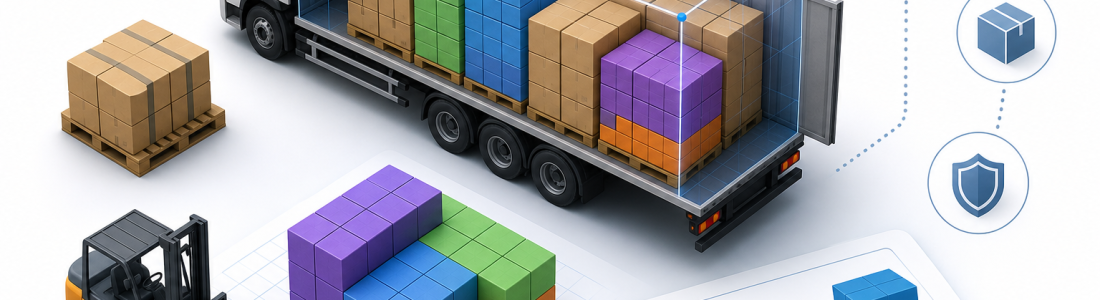
A 3D load plan is a visual loading layout showing how cartons, pallets, machinery, or other goods will fit inside a truck, trailer, container, or warehouse location. Rather than relying on total cubic metres alone, it accounts for the real length, width, height, orientation, weight, stacking limits, and loading sequence of every item.
For exporters, freight forwarders, warehouse managers, and transport planners in Spain, a sound 3D load plan helps prevent costly surprises: pallets that cannot pass through rear doors, unstable loads, wasted headroom, overloaded axles, or goods that must be unloaded and reloaded at the dock. Calculations for planning a 3D load can be completed on Cbm3.net.
The aim is not simply to fill every available centimetre. It is to create a safe, workable load that can be handled efficiently from the warehouse through to final delivery.
Table of Contents
- What a 3D load plan includes
- Why 3D loading prevents warehouse errors
- Data to collect before planning
- How to create a 3D load plan step by step
- Key calculations and practical formulas
- Example: planning a palletised export load
- Common warehouse mistakes
- Using a load simulator
- FAQ
What does a 3D load plan include?
A 3D load plan is more than a drawing of boxes inside a vehicle. It is an operational document for the warehouse and transport teams. It should show usable cargo space, the position of each load unit, empty areas, total weight, and any restrictions that affect loading.
The plan may apply to a 13.6 m curtain-side trailer, a rigid truck, a 20-foot or 40-foot container, a van, or a warehouse rack location. The principle remains the same: physical dimensions and handling rules matter as much as volume.
Essential information in a 3D load plan
- Internal vehicle or container dimensions: length, width, and height.
- Door opening dimensions, which may be smaller than the internal space.
- Dimensions of every pallet, carton, crate, or irregular item.
- Gross weight per unit and total shipment weight.
- Maximum payload and, where relevant, axle-load limits.
- Stackability, maximum stacking height, and crush resistance.
- Required orientation, such as “this side up” or non-rotatable pallets.
- Loading and unloading order for multi-drop routes.
- Lashing, blocking, anti-slip, and load-securing requirements.
Why a 3D load plan prevents warehouse errors
Many warehouse errors begin with a simple assumption: “The cubic metres fit, so the shipment will fit.” In practice, cubic capacity is only a first filter. A trailer may have enough theoretical volume but still reject the load because a pallet is too tall, too wide, non-stackable, or impossible to position without creating unusable gaps.
A 3D load plan gives dispatch staff a loading sequence before goods reach the loading bay. This reduces last-minute decisions made with a forklift and a waiting vehicle. It also helps sales, customer service, and operations work from the same shipment data when quoting freight or confirming collection dates.
In Spanish export operations, this is particularly useful for mixed pallet loads moving from Madrid, Barcelona, Valencia, Bilbao, or Zaragoza to European destinations. A shipment may include Euro pallets, industrial pallets, cartons, and fragile items on the same truck. Without a visual plan, the warehouse may discover too late that the final pallets cannot be loaded in delivery order.

Data to collect before building the plan
Accurate input data is what separates a useful simulation from an attractive but unusable diagram. Measure the loaded unit, not only the product. If cartons sit on a pallet, include pallet height, corner boards, overhang, stretch wrap, and any protective top frame.
Measure the cargo correctly
- Use external dimensions in metres or millimetres: length × width × height.
- Record the gross weight, including packaging and pallet.
- Identify whether the unit can be rotated by 90 degrees.
- Confirm whether it can be double-stacked and under what maximum load.
- Flag hazardous goods, temperature-sensitive cargo, fragile goods, or products requiring ventilation.
- Check whether forklift pockets, lifting points, or clamp handling require clear access.
Vehicle data also needs to be verified. A standard European curtain-side trailer is often described as 13.6 m long, 2.45 m wide, and around 2.70 m high internally, but usable dimensions vary by body type, roof design, wheel arches, internal posts, and equipment. A refrigerated trailer, for example, has less usable width and height than a standard tautliner.
How to create a 3D load plan step by step
1. Define the transport unit
Start with the exact vehicle, container, or storage area. Do not select a “40-foot container” without confirming whether it is standard, high-cube, reefer, open-top, or another configuration. Enter internal dimensions, door aperture, payload, and any obstructions.
2. Create a clean item list
List every handling unit separately. If an order has 18 identical Euro pallets and four oversized crates, do not treat it as 22 generic pallets. The crates may determine the entire loading pattern. Assign a reference number to each unit so the warehouse can match the plan with physical labels.
3. Apply placement rules
Set rotation permissions, stackability, weight limits, and delivery priority. Heavy pallets should normally be placed low and close to the vehicle centreline. Non-stackable units require reserved headroom; that space cannot be treated as empty air available for other goods.
4. Build the loading sequence
For a single-destination shipment, the priority is usually stable, dense loading. For a multi-drop route, load the final delivery first and the first delivery last, unless access, weight distribution, or product restrictions require a different arrangement. Mark any exceptions clearly on the loading note.
5. Check the plan at the dock
A plan is not finished when the simulation is complete. The shift supervisor should compare the actual pallets with the dimensions and labels in the plan. Damaged packaging, substituted pallets, or an extra 20 mm of height can change the result. Record deviations before loading, not after the doors are closed.
Key calculations for a 3D load plan
Volume calculations are useful, but they need to be interpreted alongside physical loading constraints.
CBM formula
CBM = length (m) × width (m) × height (m)
For example, a pallet measuring 1.20 m × 0.80 m × 1.50 m occupies:
1.20 × 0.80 × 1.50 = 1.44 m³
If there are 20 identical pallets, the cargo volume is 28.8 m³. That does not automatically mean the shipment fits in a trailer with 85 m³ of internal volume. The pallet footprint and layout determine how many positions fit in each row, while stackability determines whether the upper volume can be used.
Floor-area calculation
Required floor area = pallet length × pallet width × number of non-stacked pallets
A Euro pallet has a footprint of 1.20 m × 0.80 m, or 0.96 m². Twenty non-stackable Euro pallets require 19.2 m² of floor space before allowing for gaps, wheel arches, or securing equipment. A standard trailer floor is roughly 13.6 m × 2.45 m, or 33.32 m². On paper, the floor area works. The 3D layout confirms whether the selected orientation creates practical rows and leaves safe space for securing.
Weight and payload calculation
Total cargo weight = sum of the gross weight of all load units
Remaining payload = vehicle permitted payload − total cargo weight
Always use the permitted payload stated for the specific vehicle. Do not confuse it with gross vehicle weight. In road transport, distribution matters as well: placing dense machinery at the rear can create axle-load issues even when total weight remains legal.
Example: planning a palletised export load
Consider a shipment from Valencia to France: 24 Euro pallets, each measuring 1.20 m × 0.80 m × 1.35 m and weighing 420 kg. The pallets can be stacked only two high if the upper pallet weighs less than 450 kg and the product is protected with corner boards.
Each pallet has a volume of 1.296 m³. Total cargo volume is:
24 × 1.296 = 31.104 m³
Total shipment weight is:
24 × 420 kg = 10,080 kg
A standard 13.6 m trailer can usually accommodate 33 Euro pallets on the floor in a common layout, so floor capacity is not the issue. As the shipment contains only 24 pallets, it fits on one level. However, a 3D load plan may show that double-stacking 12 pairs offers better stability for a mixed route, leaves access for securing straps, or creates space for a later pickup. The correct choice depends on product strength and delivery requirements, not only on available cubic capacity.
The loading note should state the pallet count, total gross weight, stacking rule, loading order, and any special instruction such as “no top load”, “protect from moisture”, or “deliver with tail lift”. A loading note does not replace a 3D plan, but it turns the plan into clear instructions for the carrier and warehouse team.
Common warehouse mistakes and how to avoid them
- Using nominal dimensions: Measuring the product carton but ignoring the pallet and wrap causes height and width errors. Measure the final handling unit.
- Planning by CBM only: A shipment can have low cubic volume and still fail because of awkward footprints or non-stackable cargo.
- Ignoring door clearance: A crate may fit inside a container but not pass through the door opening. Check entry dimensions first.
- Assuming every pallet can rotate: Some goods have a fixed orientation because of labels, product stability, or unloading equipment.
- Loading heavy goods at one end: This can affect handling, vehicle stability, and axle loads. Keep weight balanced across the floor.
- Forgetting delivery sequence: Loading the first drop first can force unnecessary unloading at later stops.
- Failing to update the plan: If a pallet is replaced, damaged, or repacked, verify the new dimensions and weight.
- Leaving securing to the last minute: Straps, bars, dunnage, and anti-slip mats require space. A tightly packed load may still be unsafe if it cannot be secured.
Using a load simulator before dispatch
A load simulator is especially useful when shipments include several pallet sizes, irregular crates, or a mix of stackable and non-stackable goods. It allows the planner to test different orientations and vehicle types before goods reach the dock.
On Cbm3.net, calculations for 3D load planning, cubic metres, pallet placement, and capacity checks can be completed in one place. The site’s CBM calculator is useful for confirming shipment volume, while the 3D planning process adds the practical checks that volume alone cannot provide.
Use the result as an operational guide, not as a substitute for warehouse judgement. The person loading the vehicle still needs to check the actual goods, the available securing equipment, and the condition of the vehicle floor before dispatch.
FAQ
What is the difference between CBM and a 3D load plan?
CBM measures cargo volume. A 3D load plan shows whether the cargo can physically be placed inside a specific vehicle or container, taking account of footprints, height, rotation, weight, door access, stacking, and loading order.
How many Euro pallets fit in a 13.6 m trailer?
A standard 13.6 m curtain-side trailer commonly carries up to 33 Euro pallets on the floor, depending on the internal width and the pallet layout. This figure can change where pallets are oversized, non-rotatable, overhanging, or where securing space is needed.
Why should door dimensions be included in the plan?
Internal container or vehicle space is irrelevant if the cargo cannot pass through the opening. Always compare the full external dimensions of the loaded pallet or crate with the door width and height before confirming the plan.
Can a 3D load plan prevent axle-load problems?
It can help identify risk by showing where heavy units are placed. The final check must use the permitted payload and axle limits for the specific vehicle, especially when loading machinery, stone, metal products, or other dense cargo.
Should a 3D load plan be updated when one pallet changes?
Yes. A replacement pallet may have different dimensions, weight, packaging, or stacking limits. Even a small change can affect door clearance, load balance, securing space, or the final loading sequence.