
Quick Answer: The 53' Domestic High Cube Intermodal Loading Guide & Calculator profile (Equipment Code: 53DHC) provides an internal usable planning envelope of 1,601.9 cm L × 252.4 cm W × 278.1 cm H (52' 6.6" L × 8' 3.4" W × 9' 1.5" H (99.4" W × 109.5" H)) with a usable cubic volume of 112.44 CBM (3,971 cu ft) and a max payload capacity of 25,809 kg (56,900 lbs). The cornerstone of North American transcontinental logistics, the 53DHC provides an extraordinary 112.44 CBM (3,971 cu ft) of volume. Sized specifically for 48×40 in GMA pallets, it fits 30 pallets on the floor and up to 60 double-stacked.
Key Technical Specifications (Dual Metric & Imperial)
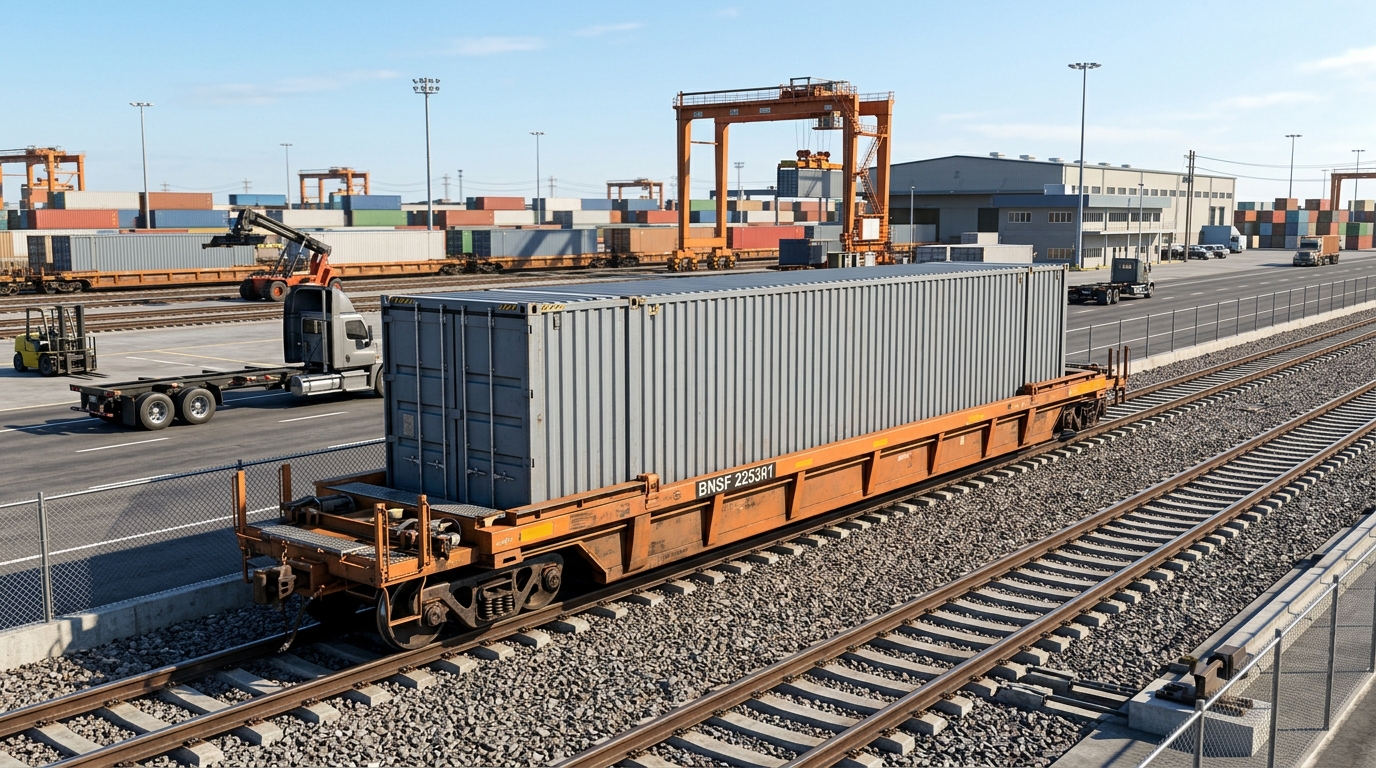
The 53′ Domestic High Cube intermodal container is the cornerstone of North American domestic double-stack rail logistics. The following technical parameters represent the validated engineering profile for 53DHC recorded in CBM3, sourced directly from certified equipment authority Union Pacific (EMP / UMAX):
| Specification Parameter | Metric (ISO Standard) | Imperial (US Standard) |
|---|---|---|
| Equipment Code & Class | 53DHC (North American Intermodal Container) | Union Pacific (EMP / UMAX) Certified |
| Internal Usable Length | 1,601.9 cm | 52 ft 6.6 in |
| Internal Usable Width | 252.4 cm | 8 ft 3.4 in (99.4 in internal) |
| Internal Usable Height | 278.1 cm | 9 ft 1.5 in (109.5 in internal) |
| Rear Door Clearance (W × H) | 248.9 × 278.1 cm | 98.0 × 109.5 in |
| Usable Internal Volume | 112.44 m³ (CBM) | 3,971 cu ft |
| Maximum Gross Mass (MGM) | 30,481 kg | 67,200 lbs |
| Tare Weight (Empty Unit) | 4,672 kg | 10,300 lbs |
| Maximum Net Cargo Payload | 25,809 kg | 56,900 lbs |
| Euro Pallets (1200×800 mm / EUR1) | 38–40 pallets on floor (76–80 double-stacked) | |
| Standard GMA Pallets (48×40 in / 1219×1016 mm) | 30 pallets on floor (60 double-stacked) | |
Pallet Loading Capacity & Floor Space Optimization
Engineered for the North American Class I rail intermodal network (Union Pacific EMP, BNSF, CSX, Norfolk Southern, UMAX), the 53′ Domestic High Cube Intermodal Container (53DHC) is optimized around the standard 48 × 40 in (1219 × 1016 mm) GMA pallet.
With an internal width of 252.4 cm (99.4 in), two 48-inch pallets can be turned sideways (turned 48-inch side) across the interior width (48 + 48 = 96 in < 99.4 in) with 3.4 inches of operating clearance. Along the 1,601.9 cm (52 ft 6.6 in) floor, shippers load 15 rows of 2 turned pallets, fitting 30 GMA pallets on the floor without pinwheeling. With a towering 278.1 cm (109.5 in) interior height, lightweight consumer goods can be double-stacked up to 60 loaded pallets.
Interactive 3D Cargo Load Simulation
Shipping across North American rail and highway corridors? Verify your double-stacked tiers and gross weight compliance in seconds with our free 53 high cube loading calculator.
Engineering & Fleet Architecture: Why 53DHC Outperforms Standard Fleets
Unlike ISO maritime containers designed for cellular ship holds, domestic 53ft containers feature intermediate 40ft stacking posts in addition to end castings. This configuration enables them to ride on the top tier of double-stack rail well cars above standard 40ft or 45ft containers. Built with heavy-duty aluminum side sheets or composite lightweight panels and scuff liners, they withstand high-frequency humping and longitudinal buff forces on transcontinental rail corridors.
Weight Distribution, Axle Limits & Transport Safety
Rail intermodal operations subject cargo to dynamic acceleration forces up to 2–3 Gs longitudinally during railcar coupling and emergency brake applications. Cargo must be blocked and braced in strict accordance with the Association of American Railroads (AAR) Intermodal Loading Guide. Maximum rail cargo payload is rated at 25,809 kg (56,900 lbs) against a 67,200 lbs gross limit; however, highway drayage at each terminus must comply with federal bridge formula limits (typically max 43,000–45,000 lbs cargo payload on standard tandem chassis).
Step-by-Step Practical Load Planning Protocol
- Confirm Equipment Code & Plate: Always verify that the physical CSC data plate, trailer VIN, or booking note specifically identifies 53DHC rather than standard equipment before starting the loading operation.
- Measure Packed Goods with Pallet Protrusions: Record cartons and unit loads with all external banding, stretch wrap, and pallet overhang included. Even 1 cm of unmeasured bulge can obstruct side walls.
- Configure Rotation & Vertical Stacking Rules: Define permissible crate orientations, fragile tops, and maximum compression ratings in CBM3 before simulating layouts.
- Execute 3D Visual Optimization: Review placed versus unplaced items, center-of-gravity balance, and lateral clearances in the 3D visualizer rather than relying solely on total cubic volume.
- Check Rear Door & Ingress Clearances: Verify that the tallest cargo units pass cleanly beneath the rear door header (278.1 cm) without striking top seals.
- Install Certified Dunnage & Load Bracing: Secure voids with heavy-duty inflatable dunnage bags, friction rubber mats, and ratchet lashing belts to prevent load shifting during transit.
6 Costly Load Planning Mistakes to Avoid
- Overlooking Pallet Overhang: A tiny 15 mm overhang on each side expands an 800 mm Euro pallet to 830 mm, immediately eliminating lateral tolerance in palletwide containers.
- Treating Volume and Payload Interchangeably: Dense freight will reach the 25,809 kg maximum weight rating long before the cubic capacity is filled.
- Ignoring Door Header Clearance: While internal ceiling height is 278.1 cm, rear door ingress height is 278.1 cm. Trying to forklift cargo matching ceiling height will hit the frame.
- Improper Longitudinal Weight Distribution: Overloading the nose or rear of the equipment causes serious axle weight violations and severe highway safety hazards.
- Assuming Uniform Fleet Sidewalls: Wall corrugation profiles vary across manufacturers. Always maintain a 15–20 mm planning margin.
- Neglecting In-Transit Dynamic Shifts: Failure to properly brace voids allows cargo to surge forward during braking, leading to carton crush and customs cargo claims.
Related Equipment Loading Guides & 3D Planners
Compare specifications, pallet stacking efficiency, and dimensional constraints with related logistics equipment:
- 20′ High Cube Palletwide Loading Guide & Calculator — 15 Euro pallet capacity, 38.5 m³ usable volume, urban maritime distribution
- 40′ High Cube Palletwide (SeaPC+) Loading Guide & Calculator — 30 Euro pallet capacity, 79.0 m³ usable volume, high-density ocean freight
- 45′ High Cube Palletwide Loading Guide & Calculator — 33 Euro pallet capacity (mega-trailer equal), 89.2 m³ volume, European shortsea
- 53′ Dry Van Trailer Loading Guide & Calculator — 26-30 GMA pallet capacity, 113.8 m³ volume, pinwheel patterns & bridge law
Frequently Asked Questions (FAQ)
How many standard 48×40 pallets fit in a 53ft intermodal container?
A 53ft domestic intermodal container accommodates 30 standard GMA pallets (48×40 in) on the floor loaded turned side-by-side in 15 rows of two. If goods are stackable, up to 60 pallets can be carried.
What is the difference between a 53ft intermodal container and a 53ft dry van trailer?
A 53ft intermodal container is a detachable shipping box that can be lifted from its chassis and stacked two-high on railcars or domestic barges. A 53ft dry van trailer has permanently attached running gear (chassis, kingpin, tandem axles) and cannot be double-stacked on trains.
What are the internal dimensions of a 53ft domestic high cube container?
The internal usable dimensions are 1,601.9 cm (52 ft 6.6 in) length, 252.4 cm (8 ft 3.4 in / 99.4 in) width, and 278.1 cm (9 ft 1.5 in / 109.5 in) height, providing 112.44 m³ (3,971 cu ft) of volume.
What is the maximum cargo weight allowed in rail intermodal shipping?
The certified container payload is 56,900 lbs (25,809 kg). However, for legal road drayage to and from rail ramps without specialized overweight permits, cargo payload is generally restricted to 42,500–45,000 lbs to comply with the 80,000 lbs gross highway limit.