
Calculate CBM for a sea shipment by multiplying each package’s outside length, width and height in metres, multiplying by its quantity, and adding the groups together. For centimetres, divide each L × W × H × quantity result by 1,000,000.
Use packed dimensions, not product dimensions. A CBM total describes shipment volume; it does not by itself determine freight cost or prove the cargo fits in a container. Start with the cargo CBM calculator or use the booking examples below.
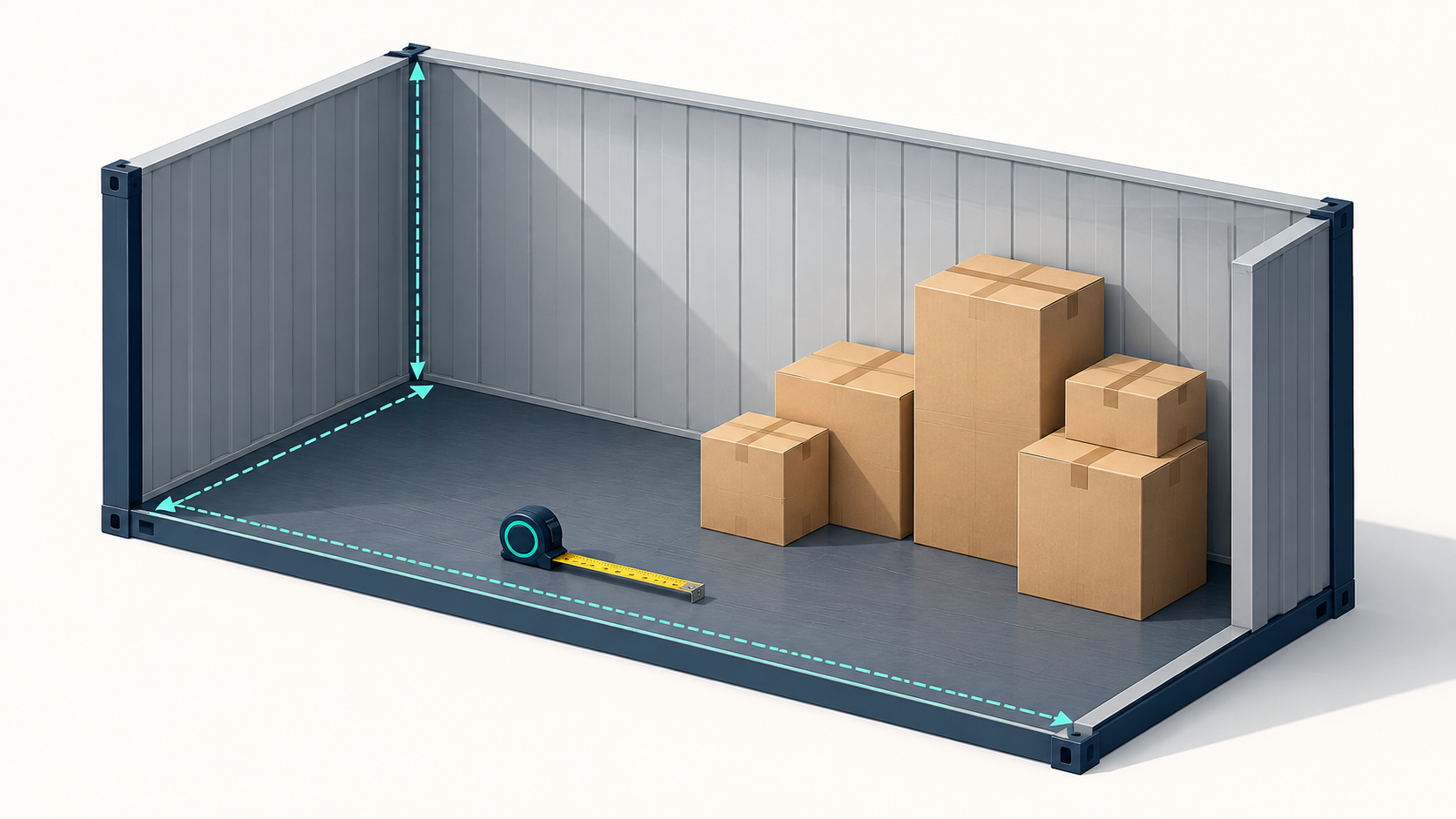
What to measure before requesting an ocean-freight quote
- Outside length, width and height of each carton, crate or complete loaded pallet.
- Quantity of each different transport-unit size.
- Gross weight, including packaging and pallet tare where applicable.
- Whether each unit may be stacked or rotated.
- Any overhang, projections, fragile contents or special handling requirements.
If cargo will be tendered as loaded pallets, measure the loaded pallet envelopes, including their bases and wrapping. Keep a carton inventory for traceability, but do not add those carton volumes again to the loaded-pallet volume.
Example 1: 50 identical cartons
Each carton measures 60 × 40 × 35 cm after packing:
60 × 40 × 35 × 50 ÷ 1,000,000 = 4.2 m3.
The volume per carton is 0.084 m3. If the packaging changes, remeasure it before booking. Keep full calculation precision and confirm the provider’s rounding and remeasurement rules.
Example 2: mixed cartons and loaded pallets
This example assumes the cartons are separate from the five loaded pallets, rather than contents of those same pallets.
| Transport units | Outside size (cm) | Quantity | Total CBM |
|---|---|---|---|
| Loose cartons | 50 × 40 × 30 | 20 | 1.20 |
| Complete loaded pallets | 120 × 80 × 160 | 5 | 7.68 |
| Shipment total | Two size groups | 25 transport units | 8.88 |
The 160 cm pallet height includes the base. The 25 transport units are not a count of the individual products packed inside them. Record both counts separately if your documents require them.
How LCL weight-or-measure charging differs from CBM
LCL means less than container load: your cargo shares a container. Under a tariff using 1 m3 or 1,000 kg, whichever gives the larger chargeable quantity, compare volume in cubic metres with gross weight divided by 1,000.
For example, 4.2 m3 at 2,100 kg gives max(4.2, 2.1) = 4.2 weight-or-measure units. At 5,600 kg, the same volume gives max(4.2, 5.6) = 5.6 units. This is a tariff example, not a live quote, and it does not change the cargo’s physical CBM.
Maersk’s LCL terms describe this 1 CBM/1,000 kg comparison for bookings calculated in weight-and-measure units. Do not assume every charge on an invoice follows it: minimums, origin and destination services, local transport, surcharges and agreed terms may use different bases. Ask the forwarder to confirm which rule applies to each quoted charge.
FCL: container space is not the same as usable cargo volume
FCL means full container load service. It does not mean the container must be physically full, and it is not simply an LCL CBM rate multiplied by a larger number. Compare actual quotations for your route, equipment and shipment.
A nominal container volume is not a promise that an equal volume of packages will fit. Long cartons may fail at the door, pallets may leave gaps, and weight or stacking restrictions may limit the load before volume is exhausted.
Check the 20DC guide, 40DC guide and 40HC guide for planning profiles and the distinction between inside dimensions, door openings and payload. Confirm the actual equipment with the provider.
From a packing list to a 3D planning check
- Calculate shipment CBM and check the arithmetic against your packing list.
- Choose the intended equipment and enter the actual transport-unit dimensions and quantities.
- Keep horizontal rotation unless the goods permit other orientations. Set stacking and weight restrictions accurately.
- Review placed and unplaced quantities, not just the volume-utilisation percentage.
- Have the real loading, restraint, handling and transport requirements checked before dispatch.
Use the box-fit workflow for cartons or the loaded-pallet workflow for complete pallet units. To compare equipment options, use the shipment container planner. These are planning aids, not guarantees of a minimum container count or transport approval.
Frequently asked questions
Do I include the pallet in sea-freight CBM?
If the goods travel on that pallet, measure the complete unit as tendered, including the base and any protruding packaging. Confirm the service provider’s measurement rules. Do not count the same cargo once as cartons and again as a loaded pallet.
Can I calculate CBM from kilograms alone?
No. Weight alone does not reveal cargo volume without a known density and packaging geometry. Enter measured dimensions and gross weight as separate data.
Does 4.2 CBM guarantee a particular container or freight rate?
No. The load’s geometry, restrictions, equipment, route and commercial terms still matter. Use a layout check for fit and a provider’s quotation for price.
Where can I check the basic formulas?
The step-by-step CBM guide includes centimetre, millimetre, inch and foot formulas plus mixed-carton examples.
Technical references and review
References: NIST Special Publication 811 for unit conversions; Maersk, Terms for Less than Container Load, Part 1, for the conditional WMU example; DHL Global Forwarding, Calculating Chargeable Weight by Air, Ocean, Road and Rail, for the distinction between chargeable weight and actual mass. Sources and arithmetic reviewed on . The examples are illustrative calculations, not a carrier quotation or a packing-engine acceptance test.