
A 40ft high cube has a nominal external envelope of 12,192 x 2,438 x 2,896 mm: 40 ft x 8 ft x 9 ft 6 in. Outside size is not the cargo space or door opening. For loading, check the interior, doorway and mass limits of the actual container separately.
This reference separates nominal exterior dimensions, a published carrier fleet example and the CBM3 software profile. The retained Hapag-Lloyd Container Specification exterior table was checked on 6 October 2026; the carrier webpage and current software example were rechecked on 7 October 2026.
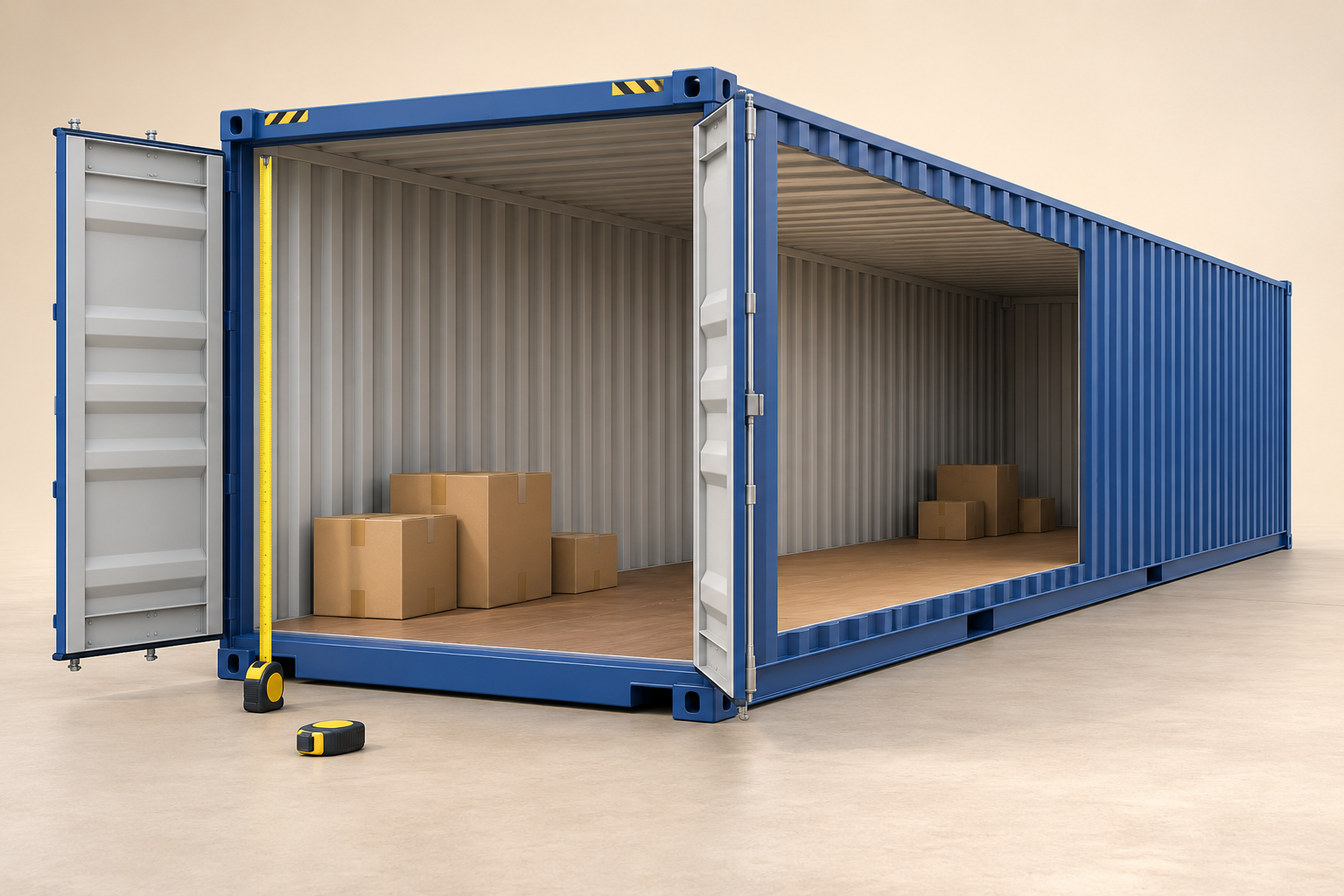
40HC Inside Dimensions and Door Opening
| Measurement | Published millimetres | Converted metres |
|---|---|---|
| Inside length | 12,032 | 12.032 |
| Inside width, specification table | 2,350 | 2.350 |
| Inside height | 2,700 | 2.700 |
| Door width | 2,340 | 2.340 |
| Door height | 2,597 | 2.597 |
The carrier’s specification table uses 2,350 mm inside width; its diagram text uses 2,352 mm. That discrepancy is retained, not silently normalized. The figures are fleet examples and may vary by manufacturer. Confirm the assigned unit.
The quoted opening is 103 mm lower than the quoted interior. An upright package can fit below the inside roof yet fail the doorway check. Include pallet height, packaging, lifting equipment and working clearance in the loading route; final-position geometry alone does not prove passage.
CBM3 Profile: Height and Cubic Volume
| Profile | Inside length x width x height (cm) | Cargo-limit input (kg) | Rectangular envelope (m³) |
|---|---|---|---|
| 40HC | 1,203 x 235 x 269 | 28,600 | 76.048 |
| 40DC | 1,203 x 235 x 239 | 28,600 | 67.566 |
The software volumes are calculated from its rounded dimensions and shown to three decimals, not promised usable cargo capacity. The carrier separately publishes 76.3 m³ for its fleet example. Do not combine one source’s dimensions with another unit’s volume or mass rating.
The default software profiles differ by 30 cm in height but have the same floor dimensions. They do not supply an actual doorway, tare or maximum gross mass. A successful geometric placement cannot fill in those missing equipment facts. Labels such as 40HC and 40HQ are search shorthand, not measurements of your assigned unit.
Open the 40HC planning starting point, then confirm the selection and actual limits before calculating. Existing loaded data and your equipment changes take precedence over a starting default; the link does not automatically plan a load.
Checked Tall-Cargo Example
This synthetic order was rechecked with the installed 11.63.55 Worker on 7 October 2026. Dimensions are length x width x height; neither row is palletized.
| Cargo | Dimensions (cm) | Quantity | Weight each (kg) | Rotation / stacking |
|---|---|---|---|---|
| Cartons | 80 x 60 x 40 | 45 | 20 | Horizontal Only; stackable |
| Tall cases | 120 x 100 x 250 | 8 | 125 | Horizontal Only; non-stackable |
Max Volume and Best Balance each placed 53 of 53 units, with 0 unplaced in one container. Entered cargo totals 32.640 m³ and 1,900 kg. The test kept normal priority, no stops, no fragile or This Side Up flags and the standard support rule. No extra stack-weight limit was entered for the synthetic cartons; that is not a real packaging-strength specification.
The tall cases retain their 250 cm height. Against the quoted 259.7 cm carrier doorway, that leaves 9.7 cm on paper, not an approved handling clearance. This is a software result, not a loading trial. Check the actual equipment and the complete package route.
Payload, Tare, Gross Mass and VGM
| Field | Carrier example (kg) | Meaning |
|---|---|---|
| Maximum gross | 32,500 | Rated combined container and load mass |
| Tare | 3,900 | Empty container mass |
| Maximum payload | 28,600 | Gross rating minus tare for this example |
For this example, 32,500 – 3,900 = 28,600 kg. Weight ratings are not a promise about every high cube or every transport route. Include relevant cargo and loading-material mass, and check applicable equipment and route restrictions.
IMO’s Verification of the gross mass of a packed container guidance describes packed-container weighing or an approved certified summation method covering cargo, pallets, dunnage, securing materials and container tare. The calculator’s known cargo subtotal is not itself a VGM declaration.
40ft High-Cube Dimensions Questions
Is 40HC the same as 40HQ?
Both labels commonly refer to a 40ft high cube. CBM3 accepts its reviewed equipment alias, but a label does not establish the exact inside dimensions, opening or mass ratings of the booked unit.
Can I use the outside dimensions to count boxes?
No. Use the verified inside envelope for final-position planning and separately check the doorway. Keep packed-unit dimensions, permitted rotation and stacking rather than relying on the exterior volume.
Will the extra height fit more non-stackable pallets?
Not automatically. These standard and high-cube profiles have the same floor area. If the finished pallets cannot be stacked, more roof height alone does not create more floor positions.
Why does the calculator show a different CBM figure?
Its rectangular volume comes from its own planning dimensions. A published carrier capacity belongs to that carrier’s equipment example. Confirm the assigned container and do not mix the two records.
Before Using the Dimensions
- Confirm interior, doorway, floor and mass limits for the assigned unit.
- Measure each complete packed unit; include pallet height and tare once.
- Keep genuine orientation, stacking and load-bearing restrictions. Extra height does not permit overturning upright-only cargo.
- Reconcile placed/unplaced quantities and resolve loading access, securing and transport checks separately.
Use the 40HC loading guide for equipment-specific planning or compare container choices for one unchanged order. This reference does not guarantee capacity, container count or transport approval.
References and Check Dates
Named references: Hapag-Lloyd, Container Specification, nominal exterior table checked 6 October 2026; Hapag-Lloyd, 40′ Standard High Cube, and IMO, Verification of the gross mass of a packed container, rechecked 7 October 2026. Software profiles and the 53-unit Worker example are separately checked under CBM3 11.63.55 on 7 October 2026.