
To calculate CBM, multiply the packed length, width and height in metres, then multiply by the number of identical packages. CBM means cubic metres (m3). It measures volume, not weight, freight price or the number of boxes that will physically fit inside a container.
For dimensions in centimetres: CBM = length × width × height × quantity ÷ 1,000,000. Use the CBM calculator to total your cargo, or follow the worked examples below.
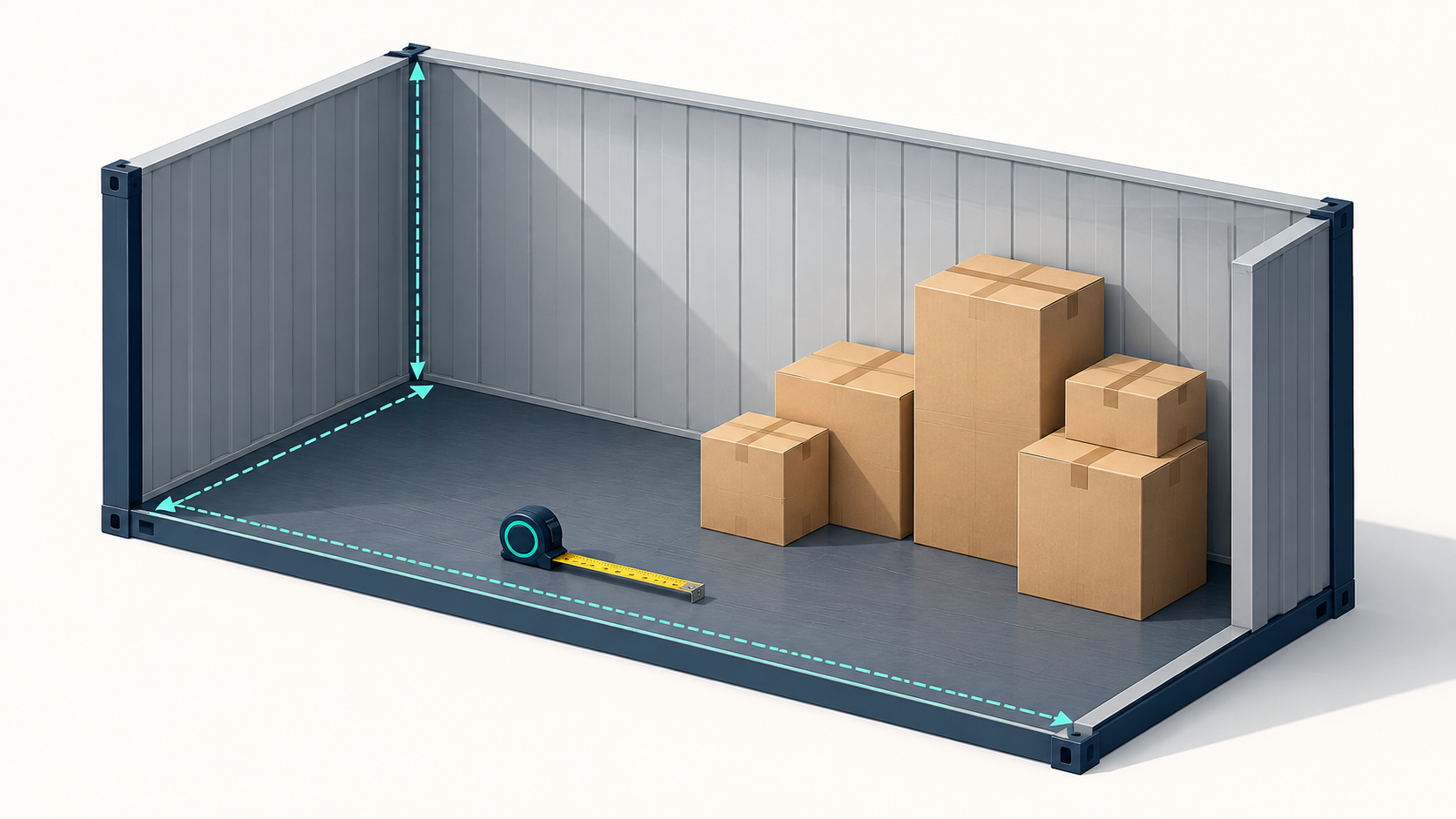
1. Measure the package as it will be shipped
Record the outside dimensions after packing, including the carton, crate, protective material and any protruding parts. Do not use a product’s unpacked dimensions for a packed shipment. Keep all three measurements in the same unit.
For a loaded pallet, measure the complete transport unit: its outside length, outside width and total height from the bottom of the pallet to the top of the load. For irregular cargo, record the bounding dimensions needed to describe the occupied space and confirm the carrier’s measurement method.
2. Choose the formula for your units
| Dimensions entered in | Formula |
|---|---|
| Metres (m) | L × W × H |
| Centimetres (cm) | L × W × H ÷ 1,000,000 |
| Millimetres (mm) | L × W × H ÷ 1,000,000,000 |
| Inches (in) | L × W × H × 0.000016387064 |
| Feet (ft) | L × W × H × 0.028316846592 |
L, W and H are length, width and height. Multiply the result by quantity only when the packages have the same outside dimensions. These conversions use the international inch and foot; keep full precision during calculation and apply any carrier-specific rounding at the end.
3. Calculate identical cartons
Suppose you have 40 cartons, each measuring 60 × 40 × 30 cm:
One carton: 60 × 40 × 30 ÷ 1,000,000 = 0.072 m3.
Forty cartons: 0.072 × 40 = 2.88 m3.
In metres, the same calculation is 0.6 × 0.4 × 0.3 × 40 = 2.88 m3. A carton measuring 24 × 16 × 20 inches instead has a volume of 0.125853 m3, rounded to six decimal places.
4. Add different carton sizes separately
Do not average the dimensions of unlike cartons. Calculate each group and add its volume to the shipment total.
| Group | Outside size (cm) | Quantity | Volume per carton | Group volume |
|---|---|---|---|---|
| A | 60 × 40 × 30 | 40 | 0.072 m3 | 2.88 m3 |
| B | 50 × 50 × 40 | 20 | 0.100 m3 | 2.00 m3 |
| Total | Two size groups | 60 | Not applicable | 4.88 m3 |
5. Treat a loaded pallet as one complete unit
A loaded pallet with outside dimensions of 120 × 80 × 150 cm occupies 1.44 m3. Six identical loaded pallets occupy 8.64 m3. In this example the 150 cm height already includes the pallet base.
Do not add the cartons’ volume again to this pallet envelope. Do not add the pallet height a second time. Palletised transport-unit volume can differ from the sum of the cartons’ volumes because of the pallet base, gaps and unused space.
Use the loaded-pallet container planner when you already know the complete pallet dimensions. Confirm gross weight and stacking permission separately; a loaded pallet should not be turned onto its side merely to improve fit.
6. Check physical fit separately from CBM
Two loads with the same CBM can require different layouts. Box proportions, allowed rotations, non-stackable cargo, door openings, payload and handling access can all prevent a nominally small load from fitting. Dividing container volume by carton volume provides only a volume-based upper bound, not a guaranteed packing result.
Use the box-fit calculator to test the quantity you intend to ship. For equipment assumptions, consult the loading-space guides. A 3D plan is a planning aid, not a certificate of securing, transport safety or mathematical optimality.
Before you send the packing list
- Check that dimensions describe packed cargo and use one unit consistently.
- Confirm the count for each size group rather than copying a total into every row.
- Use complete loaded-pallet dimensions only once.
- Record actual gross weight separately from CBM.
- Check measurement, rounding and chargeable-weight rules with the carrier.
- Review unplaced items and loading constraints before treating a volume total as a shipment plan.
Common questions
Is CBM the same as cubic metres?
Yes. CBM is a common freight abbreviation for cubic metres. One cubic metre is the volume of a cube measuring 1 × 1 × 1 metre.
How many kilograms are in one CBM?
There is no universal conversion from cargo volume to actual mass. You need the cargo density or a measured weight. A carrier’s chargeable-weight factor is a pricing convention, not a statement of the shipment’s physical weight.
Does rotating a carton change its CBM?
No. Reordering its length, width and height leaves their product unchanged. Rotation can change how cartons fit, but only use orientations the cargo can tolerate.
How is CBM used for sea freight?
The arithmetic is the same. The booking and charging rules depend on the service. See the sea-shipment CBM guide for packing-list and LCL examples.
Technical references and review
Unit conversions: NIST Special Publication 811, Appendix B, and NIST Handbook 133, Appendix E, General Tables of Units of Measurement. Worked examples on this page were independently recalculated on . They are arithmetic examples, not measured shipments or packing-engine test results.