
To optimize container loading, compare arrangements for the same shipment under the same handling rules. Check placed and unplaced quantities first, then the container distribution, access requirements and estimated weight distribution. A fuller-looking picture is not an improvement if it leaves cargo behind or changes the permissions that made the original plan valid.
Open the 3D container loading calculator to test your entered order. The examples below show what four methods produced for identical cargo, including an order that remained incomplete.
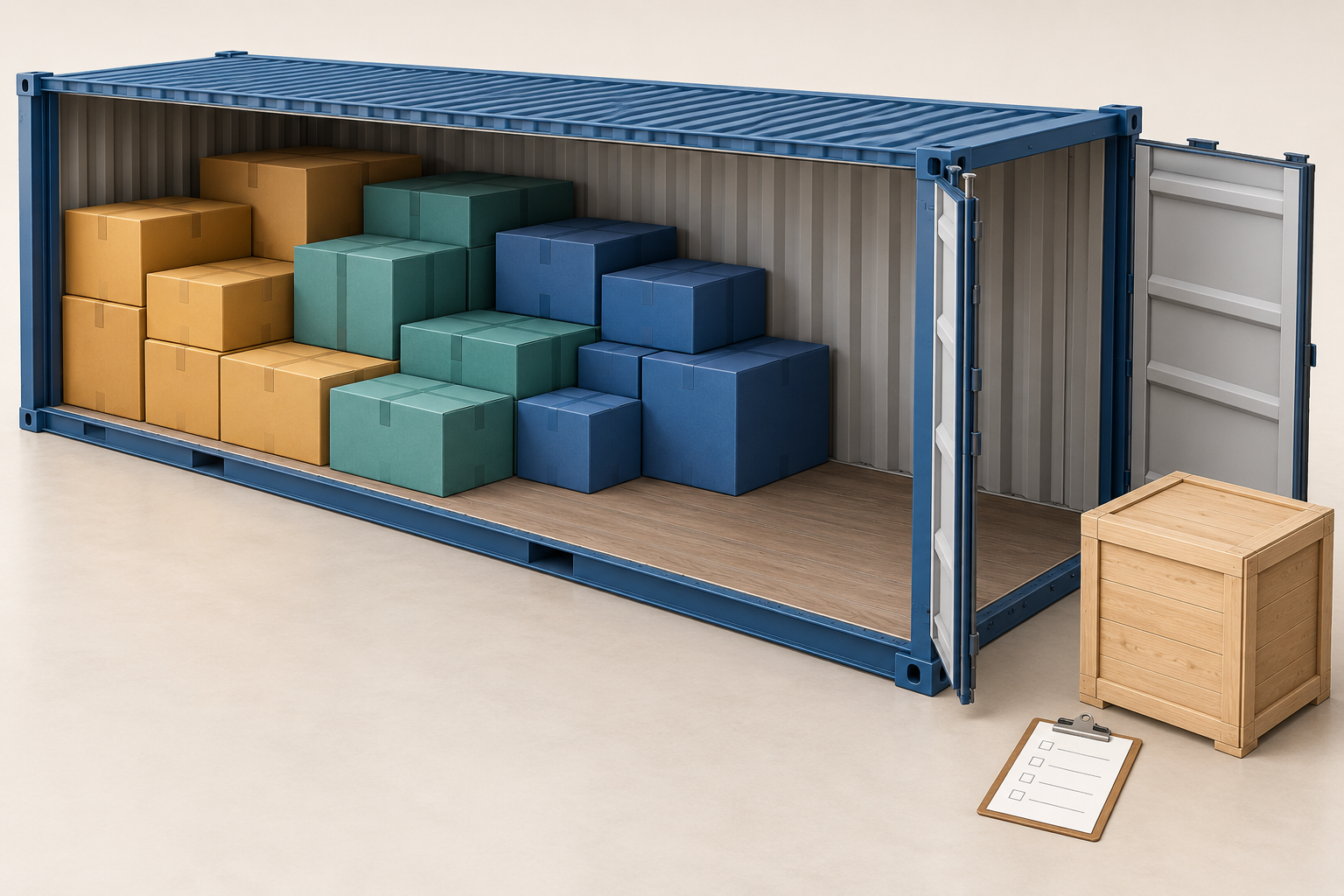
Compare Methods Without Changing the Shipment
- Confirm packed outer dimensions, quantity and weight per unit. Include packaging. For already-loaded pallets, use the complete loaded envelope and gross unit weight, with the base and tare counted once. Select the intended equipment profile and check it against the assigned equipment.
- Keep effective rules fixed. Use the same rotation permission, stackability, stack-weight limits, delivery stops and global loading rules for every method. Only enable Full 3D Rotation when the package may travel on those faces. Keep loaded pallets and This Side Up items upright.
- Compare completed results. Record the method, entered/placed/unplaced quantities and number of containers produced. Do not treat an earlier simulation as the output of a method that is still running.
- Review every container. Reconcile SKU quantities and inspect the arrangement. Handling access, known mass and remaining transport checks are separate from whether the boxes fit.
Use the step-by-step container planning guide for the basic workflow. If the equipment is the variable, use the 20ft versus 40ft comparison. A larger container is a different planning input, not evidence that one algorithm improved the same problem.
Which Loading Method Should You Compare?
For loose cargo, the initial standard plan calculates Max Volume and Best Balance. Deeper Search and Max Volume v2 are alternatives that you explicitly request. Read the actual completed output rather than assuming that the word “deeper” means more units will fit. Palletized planning follows its own single-plan flow.
PRO Optimization uses a different opt-in static model. It is not included in the same-model comparison below. Treat its confirmation and effective assumptions as part of a separate review; do not silently change that model, the support threshold or rotation permissions to make an example look better.
A configured search budget is an upper work limit, not a fixed waiting time or proof of a mathematical optimum. A method can finish earlier when it has no useful candidates left to evaluate. Compare the completed plan, not how long the progress message remained visible.
Three Reproducible Example Orders
These synthetic software tests were rechecked with CBM3 Calculator 11.63.55 on . They are not customer shipments or physical loading trials. Dimensions are length x width x height in centimetres; weights are per packed unit.
| Order | Equipment | Cargo rows | Entered total |
|---|---|---|---|
| A: mixed 55 | 20DC | 45 x (80 x 60 x 40 cm), 20 kg each; 10 x (120 x 100 x 100 cm), 125 kg each | 55 units; 20.640 m³; 2,150 kg |
| B: mixed 110 | 40DC | 90 x (80 x 60 x 40 cm), 20 kg each; 20 x (120 x 100 x 100 cm), 125 kg each | 110 units; 41.280 m³; 4,300 kg |
| C: 81 including oversize | 20DC | 80 x (120 x 100 x 100 cm), 125 kg each; 1 x (650 x 300 x 300 cm), 50 kg | 81 units; 154.500 m³; 10,050 kg |
The tested spaces were 589 x 235 x 239 cm with a 28,200 kg cargo-limit input for 20DC, and 1,203 x 235 x 239 cm with a 28,600 kg input for 40DC. These are software profiles, not universal interior, door-opening or payload specifications.
All rows used Horizontal Only, stackable boxes, normal priority, no delivery stop, no fragile or This Side Up flag, no palletization and no additional global loading rules. No explicit maximum stack weight was entered in these synthetic fixtures; real cargo needs verified stacking limits. The standard 95% support threshold stayed unchanged. Every stacked item in these recorded results had 100% geometric base support. Those percentages describe software checks, not transport approval.
What the Four Methods Placed
Each cell gives placed / entered units; containers produced. Every method received identical inputs within its order. Both advanced methods started from the same initial automatic results, not from each other’s output.
| Order | Max Volume | Best Balance | Deeper Search | Max Volume v2 |
|---|---|---|---|---|
| A: mixed 55 | 55 / 55; 1 | 55 / 55; 1 | 55 / 55; 1 | 55 / 55; 1 |
| B: mixed 110 | 110 / 110; 1 | 110 / 110; 1 | 110 / 110; 1 | 110 / 110; 1 |
| C: 81 including oversize | 80 / 81; 5 | 80 / 81; 5 | 80 / 81; 5 | 80 / 81; 5 |
Order C is not a complete shipment plan. Every method left the 650 x 300 x 300 cm unit unplaced. The other 80 units were distributed as 18, 18, 18, 18 and 8 across five containers. Five is the count produced for this exact input, not a proven minimum. The remaining 50 kg, 58.500 m³ unit still needs suitable equipment and handling.
No method placed more units than another in these three examples. Longer search can explore alternatives without increasing the placed count. These observations do not establish a universally best method or rank browser speed.
Equal Capacity Can Still Mean Different Weight Distribution
In order A, Best Balance retained all 55 units while moving the estimated centre of the entered cargo closer to the planning space’s geometric centre. The table gives the absolute distance from its length and width midpoints, rounded to two decimals.
| Method | Lengthwise offset (cm) | Widthwise offset (cm) |
|---|---|---|
| Max Volume | 57.52 | 9.59 |
| Best Balance | 0.00 | 0.00 |
| Deeper Search | 57.52 | 9.59 |
| Max Volume v2 | 57.52 | 9.59 |
A centred estimate is not a safety certificate. This example uses entered cargo weights and placed unit centres. It excludes unentered dunnage, securing materials, container tare and vehicle/chassis mass. It does not establish axle compliance, cargo restraint or verified gross mass.
Why CBM and Payload Do Not Prove Physical Fit
For identical packages with positive volume and weight, dividing available volume by unit volume and cargo allowance by unit weight gives two arithmetic limits. Rounding down the smaller value gives an upper bound before geometric and handling constraints, not the true quantity that will fit.
Orientation, dimensions, gaps, stacking restrictions, support, door access and securing space can reduce usable loading capacity. For mixed cargo, sum every row’s volume and weight, then test the actual quantities and arrangement. Replacing different cartons with one average size loses information that the planner needs.
Container Loading Optimization Questions
Is the plan with the highest volume utilization always the best?
No. First account for every ordered unit. Then compare the container count, access needs, effective rules and known mass distribution. Utilization alone does not explain an unplaced item or an unusable handling route.
Will Deeper Search always load more cartons?
No. All four methods placed the same quantities in these checked examples. Additional search is an opportunity to examine alternatives, not a promise to find a better or optimal result.
Can I rotate boxes to improve the plan?
Only when that matches their real handling permission. Horizontal Only preserves the entered vertical dimension. Full 3D is an explicit allowance for eligible cargo, not a way to override upright-only goods or loaded pallets.
How should I compare a mixed-SKU shipment?
Keep one row per packed size or SKU with the same quantity, weight and rules for each method. Sum each SKU across the containers within one alternative. Keep the unplaced list with the result.
Evidence, References and Transport Review
The installed Worker code was executed in Node for three orders and four methods. Independent audits checked row quantities, orientation, boundaries, overlaps, support, entered unit weights and payload. This is engine evidence, not a browser performance benchmark, equipment inspection or physical loading test.
Named technical reference: IMO/ILO/UNECE, CTU Code, rechecked on 7 October 2026. It provides non-mandatory guidance for packing and handling cargo transport units. A software arrangement or weight-centre estimate does not replace shipment-specific packing and securing review.
Before using a plan, reconcile the order, retain its selected method and effective rules, check the actual equipment and doorway, and resolve unplaced cargo and unanswered transport checks. Preserve the original input when testing the next alternative.