
To convert US liquid gallons to cubic metres, multiply by 0.003785411784. To convert Imperial gallons, multiply by 0.00454609. Check the gallon type first: the same number of US and Imperial gallons represents different volumes.
A cubic metre is written m3 and is often called CBM in freight. Gallons measure liquid capacity; converting that capacity into m3 does not tell you the outside shipping volume of a drum, tank, IBC or packed pallet.
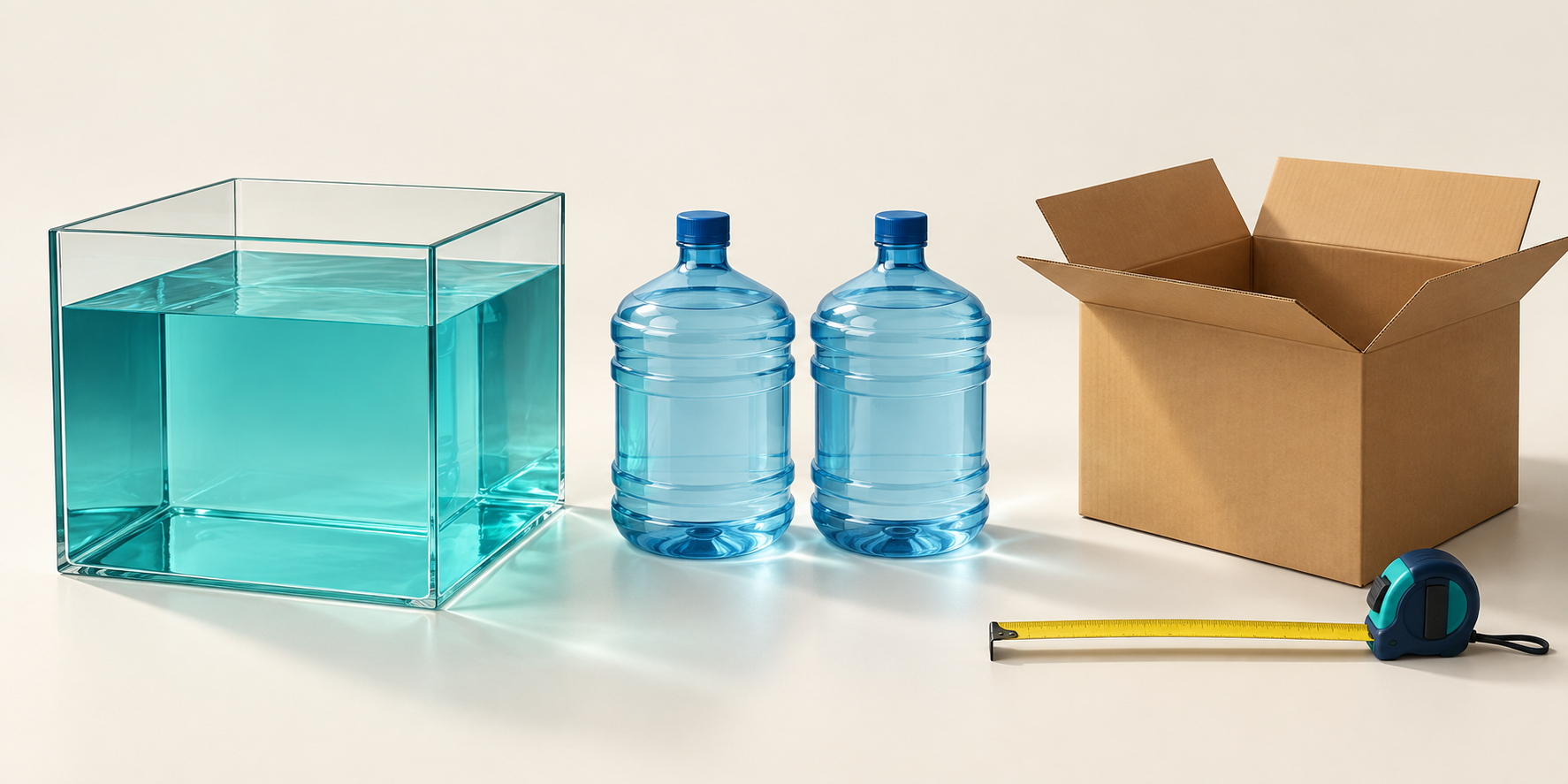
US gallons vs Imperial gallons
| Unit | Litres per gallon | Cubic metres per gallon |
|---|---|---|
| US liquid gallon | 3.785411784 | 0.003785411784 |
| Imperial gallon | 4.54609 | 0.00454609 |
These factors use the US liquid gallon, not the US dry gallon. If a specification only says “gal”, confirm its meaning with the supplier rather than inferring it from the product’s name or the website’s language. One cubic metre equals 1,000 litres.
Gallons to cubic metres formula
US liquid: m3 = gallons × 0.003785411784.
Imperial: m3 = gallons × 0.00454609.
For example, 100 US liquid gallons × 0.003785411784 = 0.3785411784 m3. The same numerical quantity in Imperial gallons gives 100 × 0.00454609 = 0.454609 m3.
Keep the full factor while calculating. Round the final value for the purpose of your document, and retain the original quantity and unit so the conversion can be checked.
Quick conversion table
| Gallons | US liquid gallons to m3 | Imperial gallons to m3 |
|---|---|---|
| 1 | 0.003785 | 0.004546 |
| 5 | 0.018927 | 0.022730 |
| 55 | 0.208198 | 0.250035 |
| 100 | 0.378541 | 0.454609 |
| 275 | 1.040988 | 1.250175 |
| 1,000 | 3.785412 | 4.546090 |
How many gallons are in a cubic metre?
Reverse the calculation by dividing cubic metres by the appropriate factor:
US liquid gallons = m3 ÷ 0.003785411784.
Imperial gallons = m3 ÷ 0.00454609.
Therefore, 1 m3 is approximately 264.172052 US liquid gallons or 219.969248 Imperial gallons. These inverse figures are rounded; use division by the original factor when precision matters.
Drums and IBCs: liquid capacity is not freight CBM
A nominal 55-US-gallon drum has a stated liquid capacity of about 0.208198 m3. That is not automatically its occupied shipping volume. The shell, closures, protective packaging, pallet and spaces between units affect the transport envelope.
Similarly, 275 US liquid gallons convert to 1.040988 m3 when rounded to six decimals. Do not enter that capacity as an IBC’s outside dimensions or assume that every IBC has the same external size.
As a separate, hypothetical packaging example, an already loaded transport unit measuring 120 × 100 × 120 cm occupies 1.44 m3 as a rectangular envelope. The example does not specify the liquid capacity, allowable fill level or structural rating of any actual product.
For cargo planning, measure the real packed outside dimensions and use the CBM calculator. If the cargo is already palletised, use the loaded-pallet container planner with complete height and gross weight. For a cylinder or irregular package, confirm the carrier’s measurement method and the handling restrictions rather than treating liquid capacity as a box.
A short conversion checklist
- Identify US liquid or Imperial gallons on the source document.
- Separate nominal capacity from the actual liquid quantity.
- Multiply by the correct m3-per-gallon factor.
- Retain precision until the final result.
- For freight, also record outside package dimensions and measured gross weight.
- Check the actual container or package specification before making a loading or filling decision.
Frequently asked questions
Can gallons be converted directly to kilograms?
Not without the liquid’s density at the relevant conditions. Gallons and cubic metres are volume units; kilograms measure mass. Packaging and pallet weight must be included separately when recording gross shipment weight.
Is an Imperial gallon the same as a US gallon?
No. An Imperial gallon is 4.54609 litres, while a US liquid gallon is 3.785411784 litres. Using the wrong factor changes the result even when the number of gallons stays the same.
How do I convert litres to cubic metres?
Divide litres by 1,000. For example, 750 litres = 0.75 m3. See the litres-to-cubic-metres guide for that conversion.
Does liquid CBM prove a shipment will fit?
No. Use the packed cargo’s geometry, quantity, weight and permitted orientations. The step-by-step cargo CBM guide explains how to measure packages before a physical fit check.
Technical references and review
References: NIST Special Publication 811, Appendix B.8, conversion factors for volume; NIST Handbook 133, Appendix E, General Tables of Units of Measurement, including the 231-cubic-inch US liquid gallon and international inch. Factors and worked examples reviewed on . Examples are arithmetic illustrations, not product specifications or actual shipment tests.